Project 1.5: VM-to-Kubernetes Migration Platform (ESXi -> KubeVirt Migration & VM Modernization)
Stage 0 status: complete, with a technical refinement pass (2026-09-27), pending user review. Nothing was installed or created. ESXi, VMware networking, Windows virtualization and AWS are unchanged.
Later outcome (note added 2026-10-15). This page records Stage 0 as it stood on 2026-09-27. Stage 1 was then approved and carried out in sub-stages 1A to 1I. Stage 1I completed the first cold migration from ESXi to KubeVirt on a temporary, Terraform-built, single-node kubeadm cluster on AWS EC2, validated it, and destroyed the target (2026-10-01). Several “unvalidated” items below were proven along the way; see the status table added to the feasibility page and the Stage 1 index. The S3 staging step in the one-line architecture was not used: Stage 1I transferred the image over SFTP and used a CDI upload (ADR 009). The migration controller (ADR 005) and the containerized version remain unimplemented.
Migration tooling hides a long chain of layers: VMware objects, disk formats, guest drivers, KVM/QEMU/libvirt, KubeVirt objects, CDI, Kubernetes storage and networking, and controller design. If we start installing before we understand that chain, every failure becomes guesswork. Stage 0 builds the mental model first, checks current (not remembered) version facts, and identifies what must be proven before any build.
| Document | Covers |
|---|---|
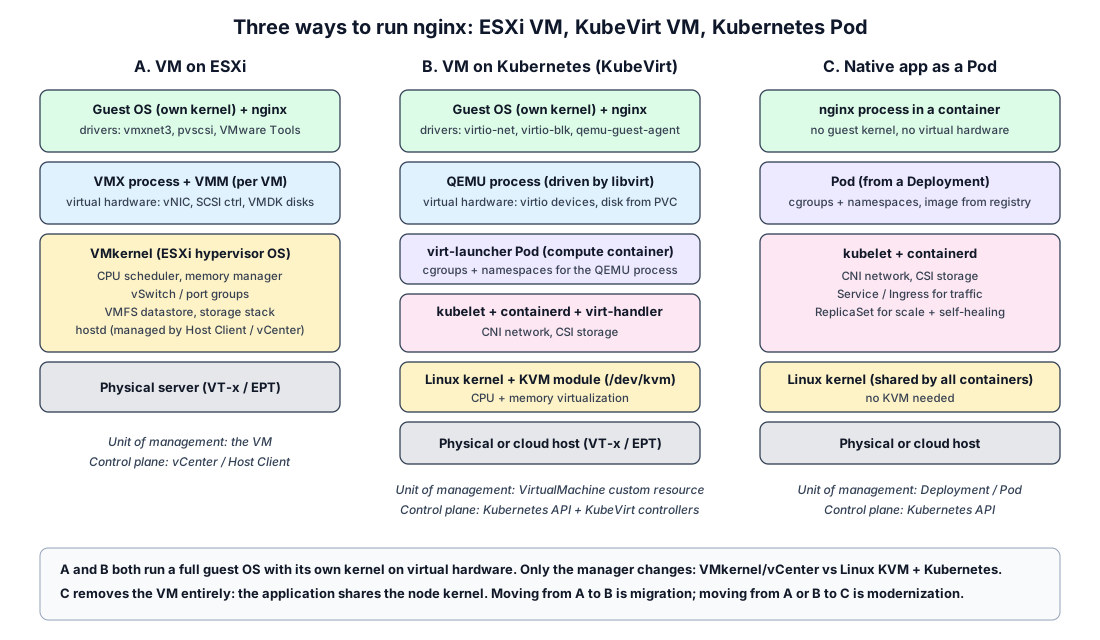
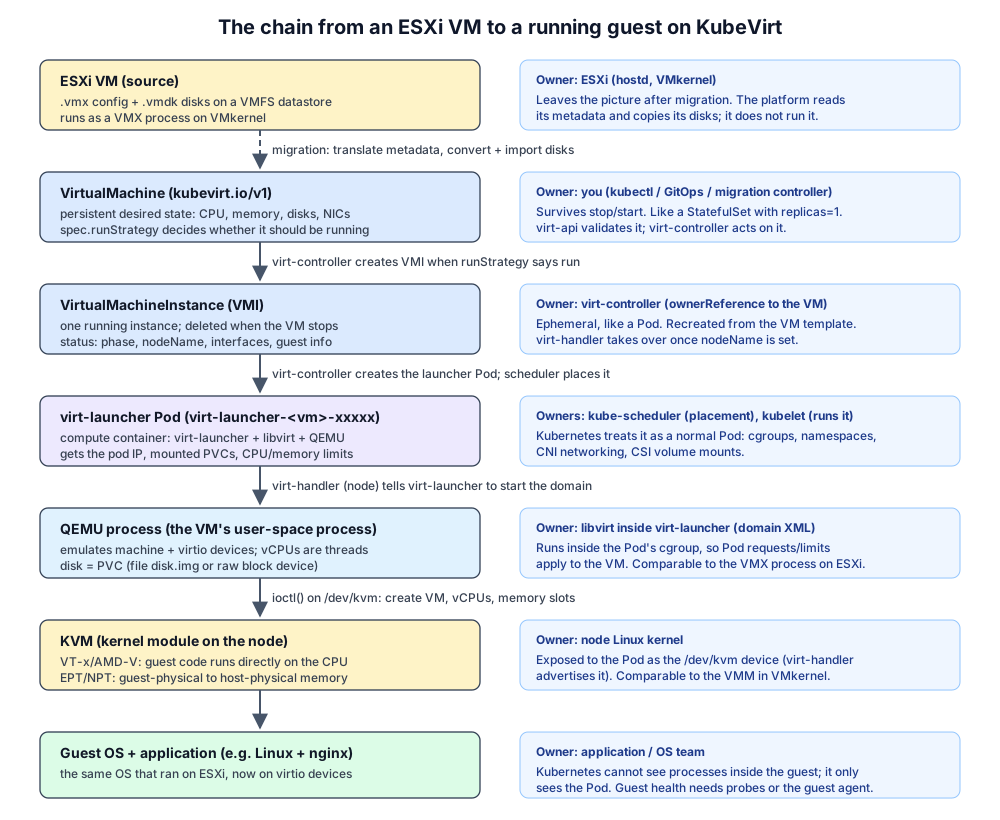
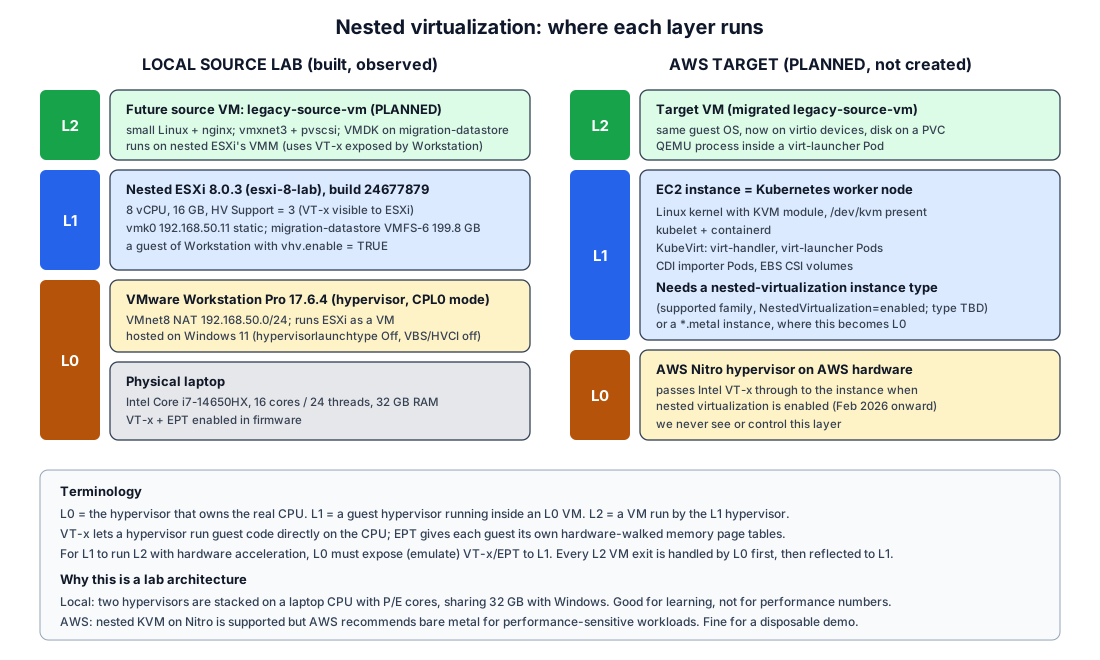
| virtualization-fundamentals.md | ESXi VM vs KubeVirt VM vs Pod; the ESXi -> guest OS chain and owners; KVM, QEMU, libvirt, VirtIO; VMware -> KVM translation table; nested virtualization (L0/L1/L2, VT-x/EPT) |
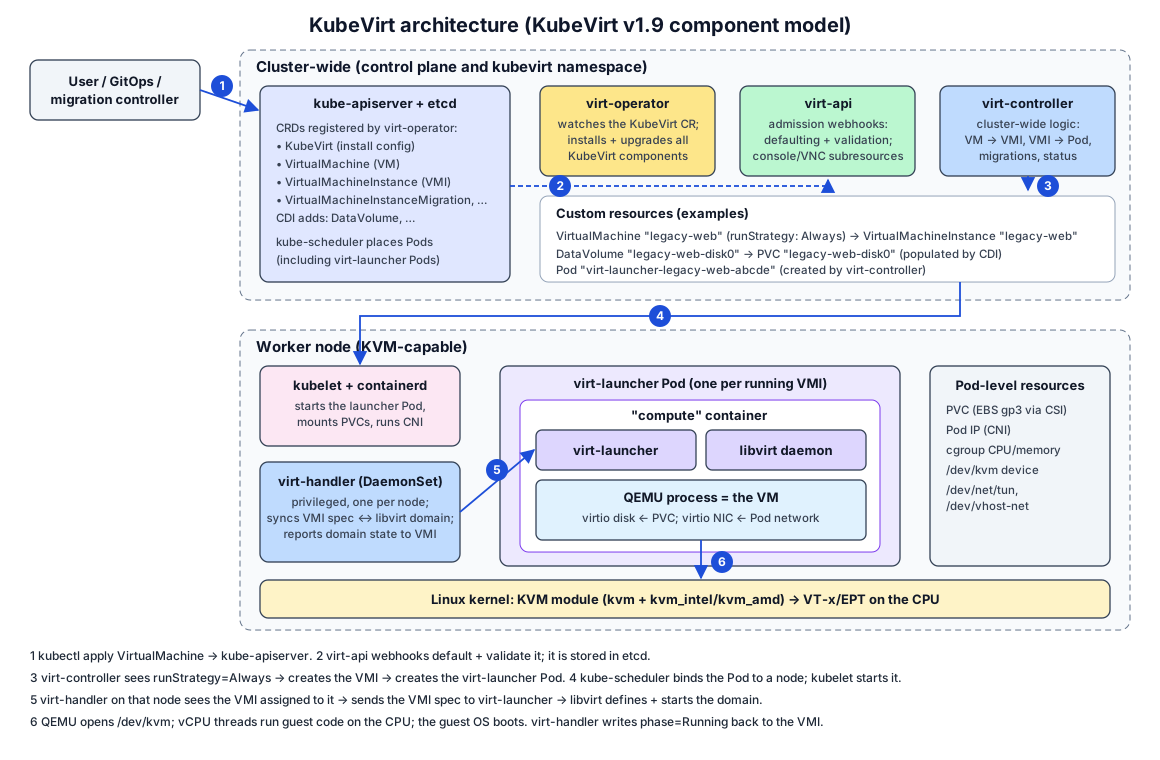
| kubevirt-architecture.md | Current KubeVirt components, VM vs VMI, lifecycle from kubectl apply to guest boot, install requirements |
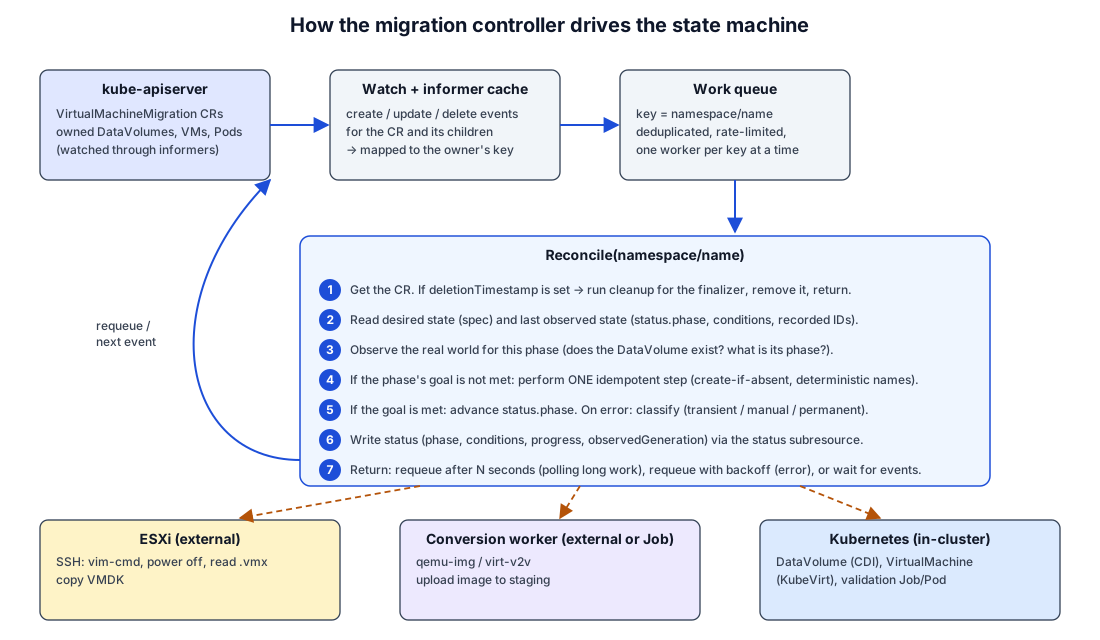
| crd-controller-fundamentals.md | CRDs, controllers, reconcile, status, conditions, finalizers; why a controller instead of scripts; the controller model mapped to our state machine |
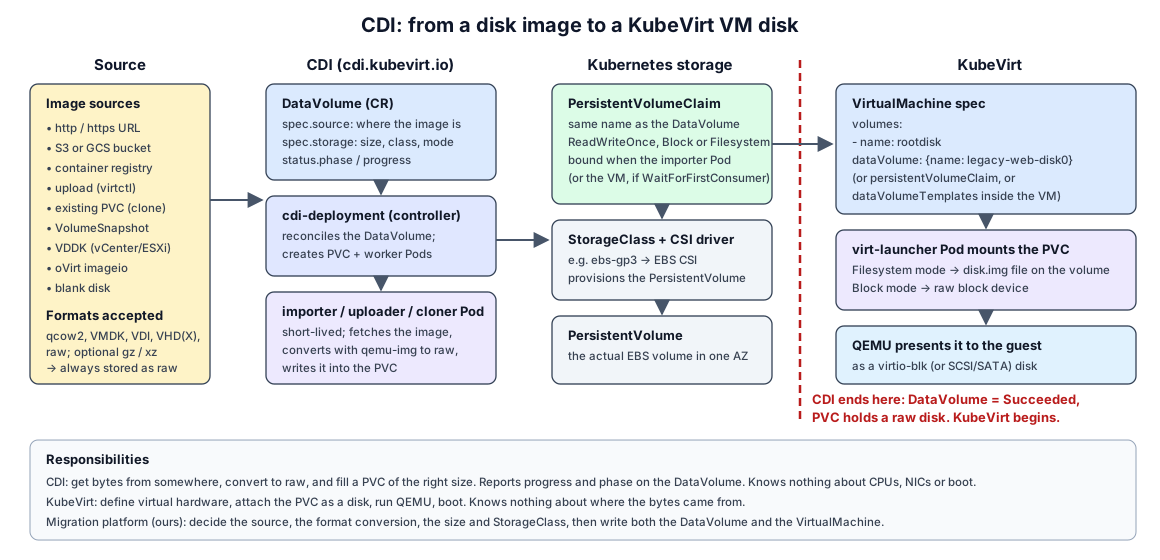
| cdi-storage-model.md | CDI, DataVolume, PVC, import/upload/clone; where CDI ends and KubeVirt begins; VMDK/QCOW2/RAW; qemu-img, virt-v2v, libguestfs; storage mapping |
| vmware-source-model.md | Our ESXi objects, what to discover, the inventory model, metadata vs disk data vs runtime state |
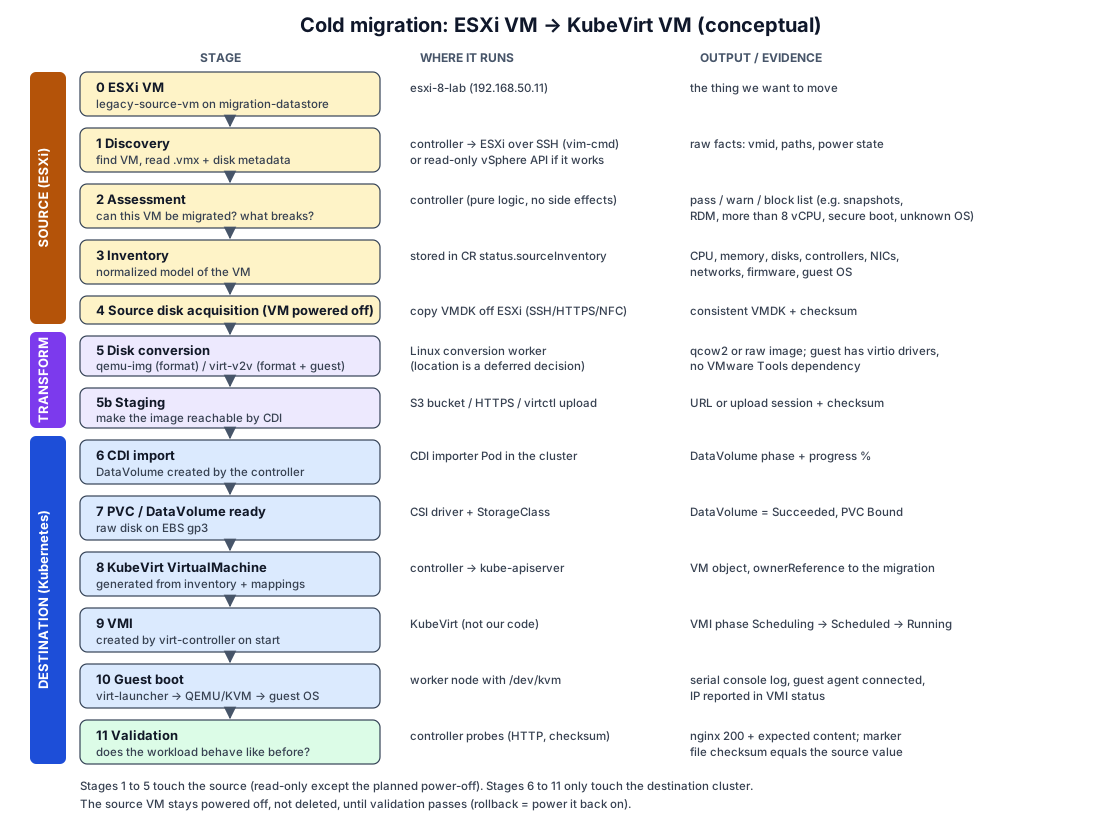
| migration-architecture.md | End-to-end migration flow, cold vs warm, MTV/Forklift as reference vs our platform, the conceptual VirtualMachineMigration CRD, the first demo design |
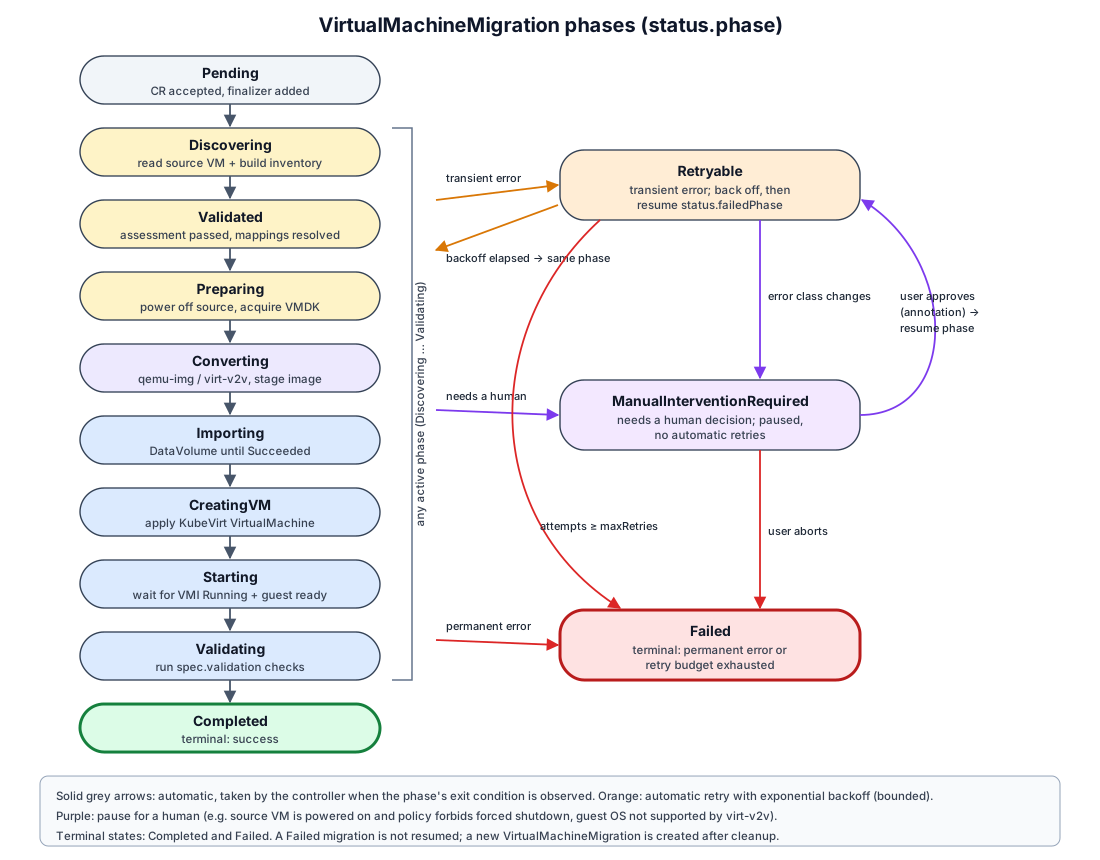
| migration-state-machine.md | Phases, automatic / retryable / terminal transitions, idempotency |
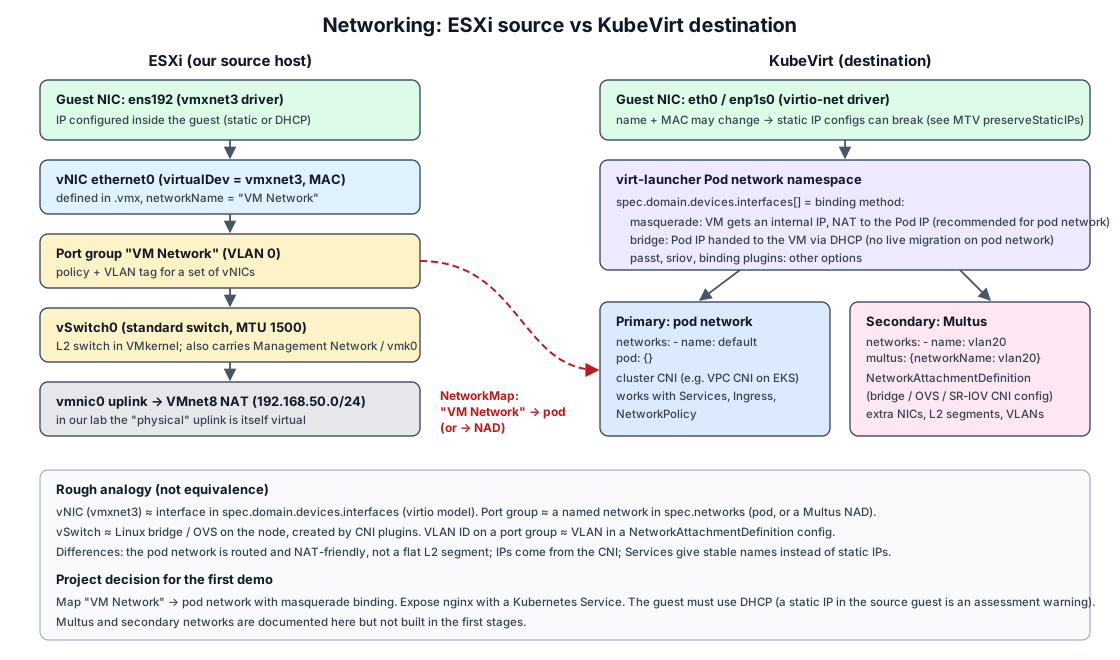
| networking-model.md | Pod network, masquerade, bridge, Multus, NAD, secondary networks vs vSwitch / port group / vNIC; network mapping |
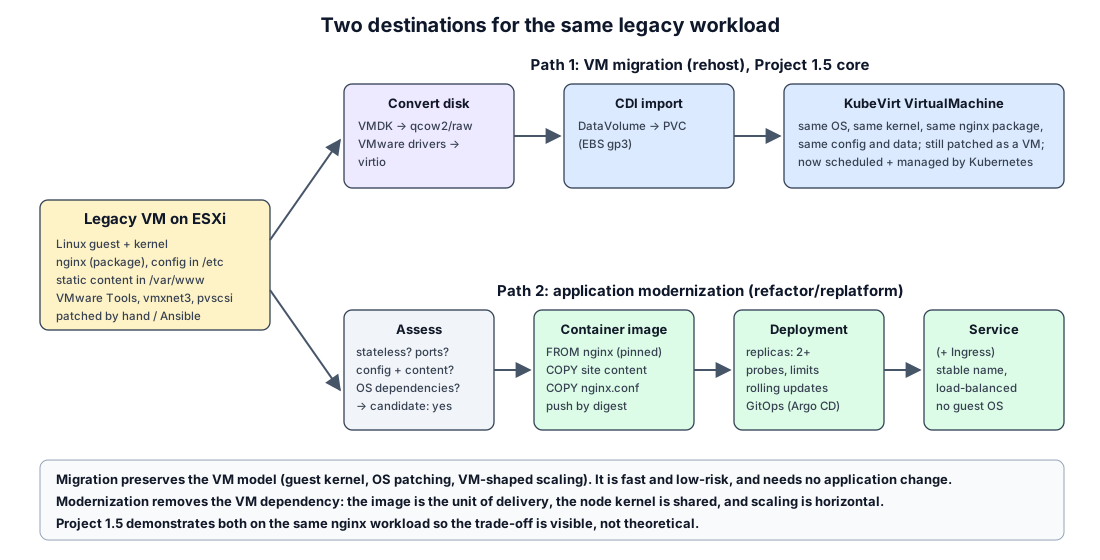
| modernization-model.md | VM migration vs application modernization, worked nginx example |
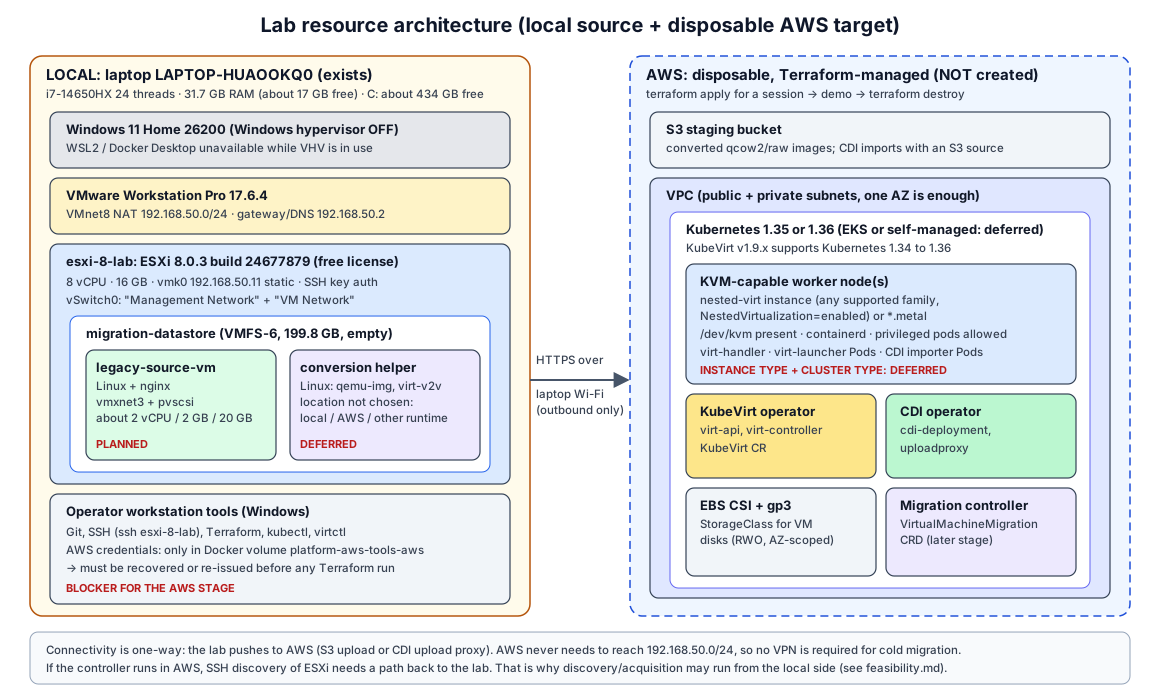
| architecture.md | End-to-end architecture, component responsibilities, lab resource architecture (local + disposable AWS) |
| feasibility.md | What must be validated before Stage 1, with status and sources |
| evidence-index.md | Summarized, non-sensitive evidence of the current lab |
| glossary.md | Terms, with VMware analogies |
| interview-notes.md | 13 interview questions with short and detailed answers |
Diagrams (all in ../diagrams/):
| Diagram | Used in |
|---|---|
| virtualization-stack-comparison.svg | virtualization-fundamentals |
| kubevirt-object-chain.svg | virtualization-fundamentals, architecture |
| nested-virtualization-layers.svg | virtualization-fundamentals |
| kubevirt-architecture.svg | kubevirt-architecture |
| cdi-import-flow.svg | cdi-storage-model |
| migration-flow.svg | migration-architecture |
| migration-state-machine.svg | migration-state-machine |
| controller-reconcile-loop.svg | crd-controller-fundamentals |
| networking-model.svg | networking-model |
| lab-resource-architecture.svg | architecture |
| modernization-paths.svg | modernization-model |
ADRs: ../adr/README.md.
VirtualMachine (you / controller) -> VirtualMachineInstance (virt-controller) -> virt-launcher Pod (scheduler + kubelet) -> libvirt domain (virt-handler) -> QEMU (libvirt) -> KVM (node kernel) -> guest OS (app team).Only facts we observed ourselves. Full list: feasibility.md, “Proven in our lab”.
| Item | How |
|---|---|
| Nested ESXi 8.0.3 build 24677879 runs on VMware Workstation | Read-only SSH (see evidence-index.md) |
ESXi sees hardware virtualization (HV Support: 3) |
Read-only SSH |
VMFS-6 migration-datastore 199.8 GB / 198.3 GB free, no VMs |
Read-only SSH |
| Static vmk0 192.168.50.11, SSH key auth, NTP in sync | Read-only SSH |
| Item | Source |
|---|---|
| KubeVirt v1.9 is built for Kubernetes 1.36 and supported on the previous two minors | KubeVirt release notes / support matrix |
| Kubernetes 1.34 EOL 2026-10-27; EKS standard support 1.34-1.36 | kubernetes.io, AWS docs |
| CDI v1.66.1 is the newest release; no official KubeVirt-to-CDI pairing statement found | CDI releases / API reference |
| AWS nested virtualization on supported non-bare-metal instances since 2026-02-16; KVM and Hyper-V; no additional cost | AWS EC2 user guide |
| Free ESXi: API unsupported / possibly read-only, no vCenter, 8 vCPU per VM | Broadcom KB + release notes |
virt-v2v -i vmx -it ssh requirements (guest shut down, no snapshots, key auth) |
virt-v2v-input-vmware(1) |
| MTV 2.11 architecture and warm-migration limits | Red Hat docs |
See feasibility.md, “Not yet proven”. Most important:
/dev/kvm on an actual AWS target node.See architecture.md. In one line: local nested ESXi source -> SSH discovery and cold disk copy -> conversion -> S3 staging -> CDI DataVolume/PVC on a disposable Terraform-built AWS Kubernetes cluster -> KubeVirt VM -> validation -> containerized version of the same app.
| Decision | Record |
|---|---|
| Local nested ESXi is the source | ADR 001 |
| AWS is the disposable target, Terraform only | ADR 002 |
| Cold before warm; no custom warm engine | ADR 003 |
| Upstream KubeVirt + CDI is the destination; versions chosen as a validated compatibility tuple at deployment time | ADR 004 |
Custom controller + VirtualMachineMigration CR owns the declarative migration workflow (reconciliation checkpoints) |
ADR 005 |
Deferred decisions:
*.metal.Stage 1 may begin only when all general criteria are met, plus the criteria for whichever track Stage 1 covers.
General (always required):
Source-side track (creating legacy-source-vm on ESXi):
migration-datastore and the VM’s port group (“VM Network”) are agreed.Destination-side track (any AWS or Kubernetes work):
terraform destroy plan and cost guardrails (tags, budget alert, session teardown) are defined.Migration track (only after both sides exist):
All checked on 2026-09-27.
KubeVirt:
CDI:
Kubernetes:
Red Hat MTV / Forklift:
libvirt, QEMU, KVM, libguestfs:
VMware / Broadcom:
AWS:
Multus: