kubevirt-vm-migration-platform
CRDs and controllers from first principles
Stage 0 learning document for request sections 5 (KubeVirt CRDs) and 14 (controller / operator model). Nothing in this document is implemented yet.
References: Custom resources, Extend the Kubernetes API with CRDs, Controllers, Operator pattern, Finalizers, Owners and dependents, API conventions: spec and status.
1. The vocabulary
| Term | Meaning |
|---|---|
| Resource | A kind of object the Kubernetes API serves, such as pods or deployments. |
| CRD (CustomResourceDefinition) | An object that tells the API server “serve a new resource type with this group, version, kind and OpenAPI schema”. After you apply a CRD, the API server stores and validates objects of that type in etcd, exactly like built-in types. |
| Custom Resource (CR) | One object of a CRD-defined type, for example one VirtualMachine named legacy-source-vm. |
| Controller | A loop that watches objects and acts to make the real world match what they ask for. A CRD on its own only stores data. Without a controller, nothing happens. |
| Operator | A controller (or set of controllers) that encodes operational knowledge for one application, usually installed with its own CRDs. virt-operator is one. |
| Desired state | What the user wants. Lives in spec. Written by users. |
| Observed state | What the controller last saw in reality. Lives in status. Written only by the controller, through the status subresource. |
| Reconcile loop | The function the controller runs for one object: read desired state, observe actual state, take one step to close the gap, record status, repeat. |
| Conditions | A list in status of typed booleans with reasons, for example type: Ready, status: "False", reason: ImportInProgress. Machines and humans read them. |
| Finalizer | A string in metadata.finalizers. While it is present, a delete request only sets metadata.deletionTimestamp. The object stays until the controller finishes cleanup and removes the finalizer. |
| Owner reference | A pointer from a child object to its parent. When the parent is deleted, garbage collection deletes the children. |
| Idempotency | Doing a step twice has the same effect as doing it once. |
| Resumability | After any interruption, the next reconcile continues from what it observes, not from the start. |
| Retry safety | A failed step can be retried without corrupting data or creating duplicates. |
2. A very small example first
Imagine a CRD for a greeting web page. The user writes only the desired state:
apiVersion: demo.example/v1
kind: Greeting
metadata:
  name: hello
spec:
  message: "Hello from the lab"
  replicas: 2
A controller for Greeting would:
- Watch
Greetingobjects and theDeployments andConfigMaps it creates. - On any event, reconcile
hello:- Does a
ConfigMapnamedhellowith this message exist? If not, create it. If it differs, update it. - Does a
Deploymentnamedhellowith 2 replicas mounting that ConfigMap exist? If not, create it. - Set owner references so deleting the
Greetingdeletes both children.
- Does a
- Write status:
status:
  observedGeneration: 3
  readyReplicas: 2
  conditions:
  - type: Ready
    status: "True"
    reason: DeploymentAvailable
    lastTransitionTime: "2026-09-27T10:00:00Z"
If someone deletes the Deployment by hand, the watch fires and the next reconcile recreates it. That is the core idea: the controller does not run a script once; it keeps converging reality to the spec.
3. KubeVirt’s CRDs are the same idea
VirtualMachineis a CR. Its controller (inside virt-controller) watches it and creates or deletes aVirtualMachineInstanceto matchspec.runStrategy.VirtualMachineInstanceis a CR. Its controller creates a virt-launcher Pod. virt-handler, a node-level controller, makes the libvirt domain match the VMI.- Status flows back up: domain state -> VMI
status.phase-> VMstatus.printableStatusand conditions. - KubeVirt also uses CRDs for
KubeVirt(install config),VirtualMachineInstanceMigration(live migration),VirtualMachineSnapshot, instance types and preferences. CDI addsDataVolume,CDI,StorageProfileand others.
4. Why the migration platform should be a Kubernetes-native controller, not scripts
A migration is long-running (minutes to hours), multi-step, and touches external systems (ESXi, object storage, CDI, KubeVirt). Things fail halfway.
| Concern | Collection of scripts | Kubernetes-native controller |
|---|---|---|
| Where is the state? | In a terminal, a log file, or a person’s head | In the CR’s status, stored in etcd, visible with kubectl get |
| Crash halfway | Re-run and hope; may duplicate work | Reconcile resumes from the recorded phase |
| Retries | Hand-written loops | Built into the work queue with rate limiting and backoff |
| Concurrency | Two people can run the same script | One object key is processed by one worker at a time |
| Audit / history | Whatever was logged | Conditions, Kubernetes Events, timestamps |
| Access control | SSH keys and shell access | Kubernetes RBAC on the CR |
| Declarative / GitOps | No | The migration request is YAML in Git |
| Cleanup | Manual | Finalizers and owner references |
| Integration | Custom | Watches DataVolume / VM status natively |
Scripts are still useful. They are how we will learn each step by hand in early stages, and they can become the “actions” the controller calls. The decision is recorded in ADR 005.
5. The controller model in detail
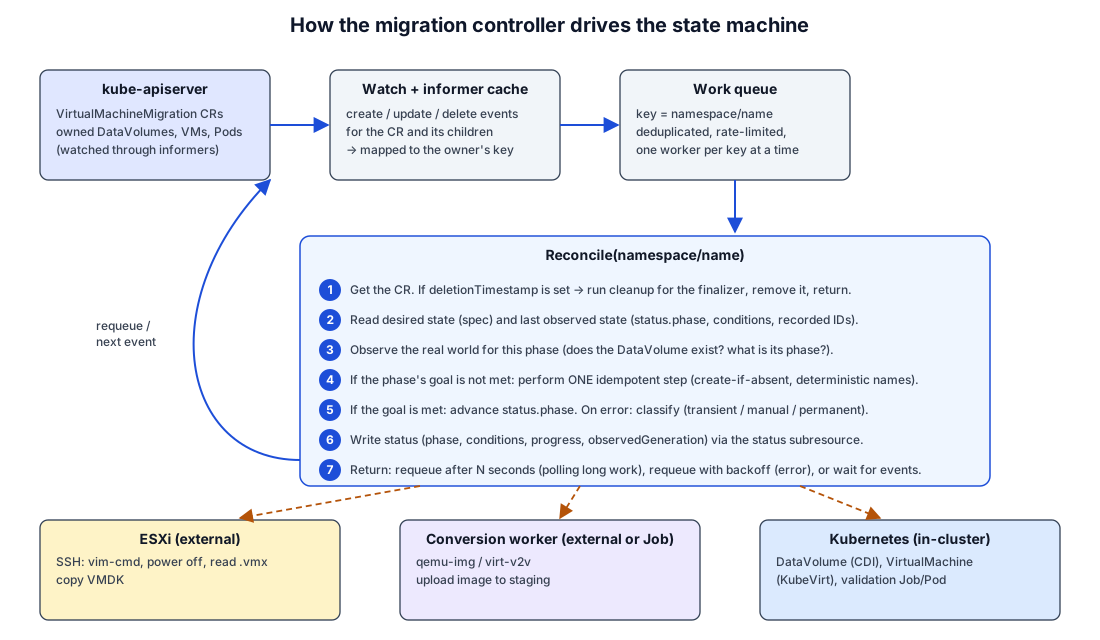
Watch
The controller uses informers: a long-lived watch against the API server plus a local cache. It watches the primary type (VirtualMachineMigration) and the secondary types it creates (DataVolume, VirtualMachine, Jobs). Events on a child are mapped back to the owner’s key through owner references.
Queue
Events do not call the reconcile function directly. They put a key (namespace/name) on a work queue. The queue:
- deduplicates: ten events for the same object become one reconcile;
- serializes per key: one object is never reconciled by two workers at once;
- rate-limits and backs off: failed keys are retried with increasing delay.
Reconcile
Reconcile(namespace/name) must be written as “look at the world, do the next step”, never as “remember what I did last time in memory”. It may be called at any moment, any number of times, including after a controller restart.
Desired vs observed state
- Desired: the
spec(which VM, which destination namespace, which StorageClass, which network mapping). - Observed:
statusplus what the controller can see right now (does the DataVolume exist, what is its phase).
Idempotency
Calling reconcile twice must have the same effect as calling it once. Techniques:
- Deterministic names for everything the controller creates (for example
DataVolume=<migration-name>-disk-0). Before creating, check whether it already exists. - Create-if-absent / update-if-different instead of “create”.
- Record external IDs in status before moving on (for example the staged image URL and checksum).
- Check the external state before acting (is the source VM already powered off? is the image already uploaded?).
- Advance the phase only after the step’s outcome is observed, and write the new phase in the same status update as the evidence for it.
Retries
- Transient errors (network timeout, API conflict, ESXi busy): return an error or requeue with backoff. Phase stays the same, and a counter in status tracks attempts.
- Retryable-but-bounded errors (conversion failed once): move to a
Retryablestate with a retry budget. - Permanent errors (unsupported guest OS, source VM missing): stop and mark
FailedorManualInterventionRequiredwith a clear reason.
Conditions
Conditions summarize state for humans and tools independently of the phase, for example:
| Type | Meaning |
|---|---|
SourceDiscovered |
Inventory read successfully |
Validated |
Pre-flight checks passed |
DiskConverted |
Converted image exists and checksum recorded |
DiskImported |
DataVolume Succeeded |
VMCreated |
VirtualMachine exists |
VMStarted |
VMI observed Running |
GuestReady |
Guest booted and validation passed |
Ready |
Whole migration done |
Each condition has status, reason, message, lastTransitionTime and observedGeneration, following Kubernetes API conventions.
Finalizers
Our CR would carry a finalizer such as migration.platform.example/cleanup. If a user deletes a migration halfway, the controller gets a chance to delete staging images, conversion Jobs and half-imported DataVolumes before the object disappears. Finalizer names must be qualified (domain-prefixed). The controller must never touch the source VM during cleanup, other than returning it to its original power state if the spec asked for that.
6. Mapping the state machine onto reconciliation
The migration state machine represents declarative reconciliation checkpoints, not a procedural script. Each phase names the desired state the controller is currently trying to make true. status.phase is the controller’s current reconciliation state, not a log of what happened. On every reconcile the controller re-observes the real system and decides again; it never assumes that an action it issued earlier succeeded.
Five properties make this work:
| Property | What it means here |
|---|---|
| Desired state | What must be true to leave the current checkpoint, derived from spec + status.phase. |
| Observed state | What the controller sees now (objects, Jobs, files, ESXi power state), read fresh on every reconcile. |
| Idempotency | Repeating a step has the same effect as doing it once (deterministic names, create-if-absent). |
| Resumability | After a crash or restart, the next reconcile continues from the observed state, not from the beginning. |
| Retry safety | Partial results are detected and resumed or cleaned before a retry, so retries never corrupt data or duplicate objects. |
VirtualMachineMigration CR
        |
        v
   controller (Reconcile)
        |
        v
   read status.phase = current checkpoint ------------+
   (derive desired state for this checkpoint)         |
        |                                             |
        v                                             |
   observe actual state NOW                           |
   (DataVolume phase, Job status, ESXi power state)   |
        |                                             |
        v                                             |
   compare desired vs observed                        |
        |- already satisfied -> no action              |
        |- absent            -> start (idempotent)     |
        |- partial           -> resume / wait          |
        |- failed            -> classify, clean, retry |
        v                                             |
   update status (phase, conditions, progress, errors)|
        |                                             |
        v                                             |
   reconcile again (requeue / watch event) -----------+
Example for the Importing checkpoint:
- Desired state: DataVolume
<name>-disk-0exists, is owned by this migration, and hasstatus.phase: Succeeded. - Observed state (read every time): absent /
PendingorWaitForFirstConsumer/ImportInProgress/Succeeded/Failed. - Controller action: absent -> create it (deterministic name, owner reference); in progress -> nothing, copy progress and requeue in 30 seconds;
Succeeded-> nothing;Failed-> classify: transient -> delete and recreate within the retry budget (Retryable), permanent ->Failed. - Status:
DiskImportedcondition,status.progress, DataVolume name, error details. - Next reconcile: re-observe; if
Succeeded, setDiskImported=Trueand move the checkpoint toCreatingVM.
If the controller restarts in the middle, nothing is lost: the phase says Importing, the DataVolume either exists or not, and the same logic picks up where reality is. The same pattern for Preparing, Converting, CreatingVM, Starting and Validating is in migration-state-machine.md.