kubevirt-vm-migration-platform
KubeVirt networking model
Stage 0 learning document for request section 15. Conceptual only. No Multus networking is built in Stage 0.
DOCUMENTED: KubeVirt: Interfaces and Networks, Multus CNI, Kubernetes cluster networking.
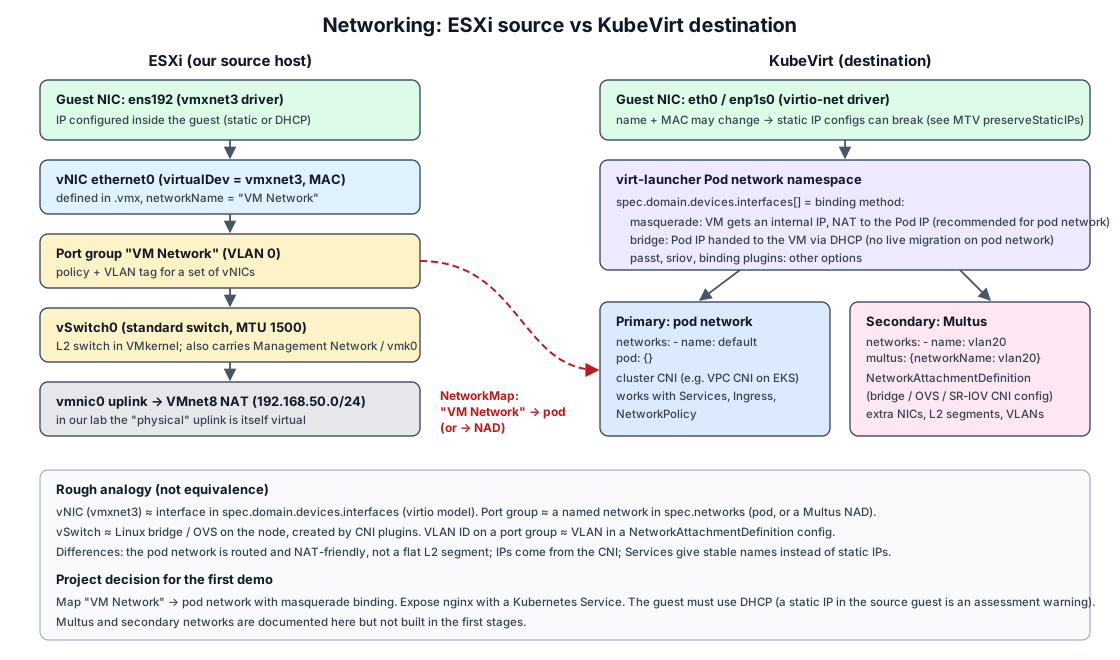
1. The two halves of a VM network in KubeVirt
A KubeVirt VM declares networking in two lists:
spec.template.spec.networks: where a NIC connects (the pod network, or a Multus network).spec.template.spec.domain.devices.interfaces: how the NIC is presented to the guest and wired to that network (the binding:masquerade,bridge,sriov, or a binding plugin such aspasst), plus model (virtio) and optional MAC.
The important mental model: the VM lives inside a Pod. Every VM NIC first lands in the virt-launcher Pod’s network namespace. The binding decides how traffic crosses from the guest’s virtual NIC into that namespace, and then CNI takes it from there like any Pod.
guest eth0 (virtio-net)
  -> QEMU tap device inside the virt-launcher Pod network namespace
  -> binding (masquerade NAT, or in-pod bridge)
  -> pod interface eth0 (from the cluster CNI) or net1 (from Multus)
  -> node networking -> other Pods / Services / outside
2. Concepts
| Concept | What it is |
|---|---|
| Pod network | The cluster’s default network provided by the CNI plugin (for example the Amazon VPC CNI on EKS). Every Pod gets one IP. In KubeVirt it is declared as networks: [{name: default, pod: {}}]. |
| masquerade binding | The guest gets a private address from a small DHCP server inside virt-launcher. Outbound traffic is source-NATed to the pod IP (using nftables). Inbound traffic to declared ports is forwarded to the guest. Works with Services and live migration. Recommended for the pod network. |
| bridge binding | The pod interface is bridged to the guest NIC, and the guest takes over the pod’s IP (via built-in DHCP). If interfaces is omitted entirely, KubeVirt defaults to bridge on the pod network. Bridge on the pod network does not support live migration. Commonly used on secondary networks. |
| passt (binding plugin) | User-space networking that maps the guest to the pod IP without privileged NAT rules. |
| SR-IOV | Passes a virtual function of a physical NIC to the guest for near-native performance. Needs special hardware. |
| Multus | A “meta” CNI plugin that lets a Pod have extra interfaces beyond the default one, by calling other CNI plugins. |
| NetworkAttachmentDefinition (NAD) | A CRD (from the Network Plumbing WG) that Multus reads. Each NAD holds a CNI config, for example “bridge br-vlan20 on the node” or “macvlan on eth1”. |
| Secondary network | Any network other than the pod network. In KubeVirt: networks: [{name: legacy, multus: {networkName: vlan20-nad}}] with a bridge interface. The guest gets an L2 port on that network, often with its original IP plan. |
3. Comparison with ESXi
| ESXi | KubeVirt | Similarity | Difference |
|---|---|---|---|
| vNIC (VMXNET3/E1000e) | interfaces[] entry, model virtio |
Both are the device the guest sees, with a MAC | Guest driver changes from vmxnet3 to virtio_net. |
| Port group (name + VLAN + policy) | networks[] entry: pod: {} or multus: {networkName: <NAD>} |
Both are “the named network a NIC plugs into” | The pod network is L3-routed with one IP per Pod, not a VLAN you pick. Only a Multus NAD resembles a port group. |
| vSwitch (L2 switch in VMkernel, with uplinks) | The node’s CNI dataplane (VPC CNI, OVS, Linux bridge) and the in-pod plumbing | Both forward frames/packets between VMs and the outside | Split between CNI on the node and the binding inside each Pod. No single switch object. |
| VLAN on a port group | NAD using a bridge or macvlan plugin with a VLAN, on a node interface trunked to that VLAN | Same L2 idea | Needs node-level network setup. On AWS, VLAN trunking to instances is not available the way it is in a data center. |
VMkernel adapter (vmk0) |
Node IP (not visible to VMs) | Host management traffic | - |
| Distributed switch (vCenter) | CNI config is cluster-wide by nature | Central config | - |
4. Mapping VMware networks to KubeVirt destination networks
Every source NIC must be mapped to a destination network before migration, or the VM arrives without connectivity. This is why MTV has a NetworkMap, and our CRD has spec.network.mappings.
VMware network (port group "VM Network", VLAN 0, NIC vmxnet3, MAC 00:0c:29:..)
   |
   v
mapping decision
   |- Pod network + masquerade   (default for our demo: reachable via a Kubernetes Service)
   |- Multus NAD + bridge        (when the VM must keep its L2 segment / IP / MAC)
   v
KubeVirt destination network (interfaces[].masquerade or .bridge, model virtio, optional macAddress)
What the mapping has to decide:
- Which destination network per source port group.
- Which binding (masquerade for pod network; bridge for secondary networks).
- IP addressing: with masquerade the guest must use DHCP inside the Pod (a static IP from ESXi will not work as-is). Keeping a static IP needs a secondary network where that subnet exists. MTV’s
preserveStaticIPshandles this for some guests; we will not in v1alpha1. - MAC address: keep it (licensing, DHCP reservations) or let KubeVirt generate one.
- Guest OS config: the interface name may change (for example
ens192on VMware toenp1s0on virtio). Netplan/NetworkManager configs that match on name or MAC may need fixing. virt-v2v helps with some of this.
5. Our plan
- Demo: one NIC, pod network, masquerade binding, guest uses DHCP, exposed through a Kubernetes
Service. No Multus. - Later (optional): a Multus secondary network, to learn the “port group” equivalent. Deferred; not needed for cold migration of a single web VM.
- Connectivity lab -> AWS is one-way for cold migration: the lab pushes the converted image to S3 (or uploads to CDI). No VPN is required for that (INFERRED; see feasibility.md).