kubevirt-vm-migration-platform
Project 1.5 architecture (Stage 0 view)
This document ties the Stage 0 material together: the end-to-end architecture, the lab resource architecture (request section 19), and the boundaries between components. It is a design, not a build. No AWS resources, clusters or VMs were created in Stage 0.
1. End-to-end view
SOURCE (local, exists)                     TRANSFER                   DESTINATION (AWS, planned, disposable)
------------------------                   --------                   --------------------------------------
Windows 11 + VMware Workstation 17.6.4                                Terraform-built VPC + Kubernetes cluster
  esxi-8-lab (ESXi 8.0.3, 192.168.50.11)                              (Kubernetes 1.35 or 1.36)
    migration-datastore (VMFS-6)                                        KVM-capable workers (nested-virt EC2 or .metal)
      legacy-source-vm (planned)                                        KubeVirt + CDI (versions = validated tuple)
        .vmx + VMDK files                                               EBS CSI (gp3) for VM disks
            |                                                           S3 bucket for image staging
            | discover (SSH + vim-cmd), power off, copy VMDK                  |
            v                                                                |
   conversion (qemu-img / virt-v2v)  --- upload converted image --->  S3 --> CDI DataVolume --> PVC
   location deferred: local helper Linux,                                       |
   AWS helper, or another Linux runtime                                         v
                                                                      KubeVirt VirtualMachine -> VMI -> virt-launcher
                                                                        -> QEMU/KVM -> guest (nginx)
                                                                                |
                                                                      validation (HTTP via Service)
                                                                                |
                                                                      modernization: same nginx content as a
                                                                      container image -> Deployment -> Service
Detailed views:
- Layers and owners: virtualization-fundamentals.md,
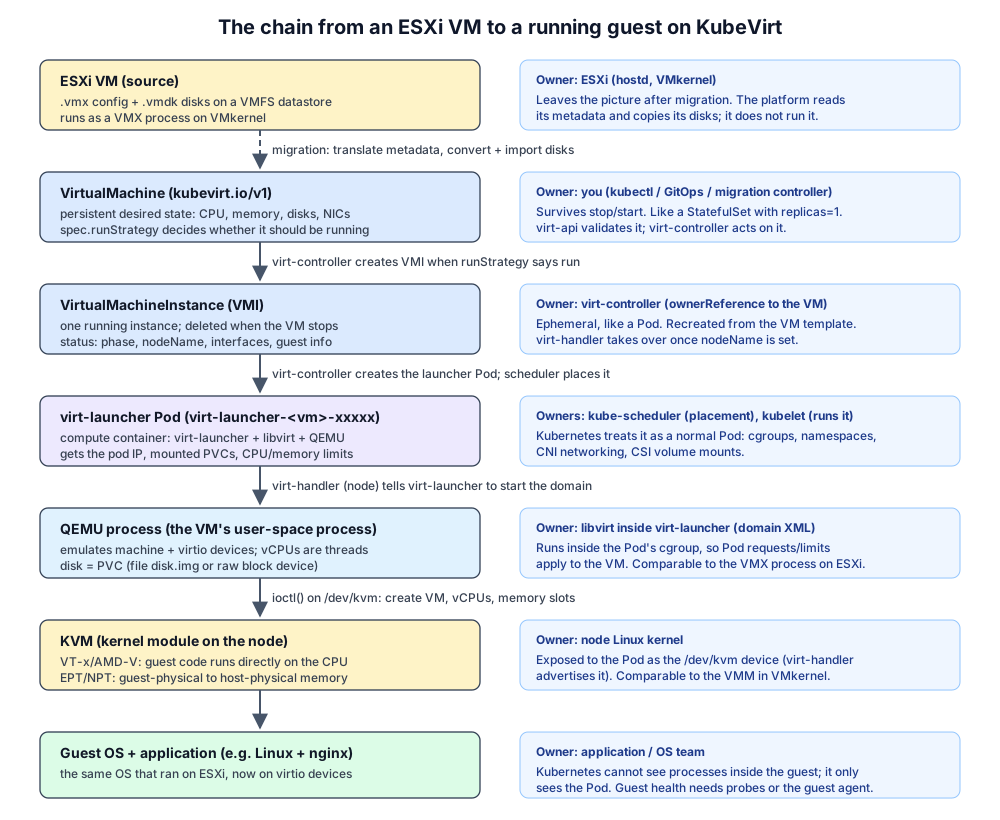
- KubeVirt internals: kubevirt-architecture.md
- Disk path: cdi-storage-model.md
- Workflow, CRD and demo: migration-architecture.md
- State machine: migration-state-machine.md
- Networking: networking-model.md
2. Component responsibilities
| Component | Responsibility | Does NOT do |
|---|---|---|
| ESXi source | Runs the legacy VM; exposes SSH for discovery and disk read | Push anything to AWS |
| Migration controller (future) | Owns the VirtualMachineMigration state machine; calls actions; writes status |
Hypervisor work, disk import internals |
| Conversion worker (future) | Converts VMDK -> qcow2/raw, optionally virt-v2v guest conversion; uploads to staging | Decide phases |
| S3 staging | Holds converted images temporarily | Long-term storage (lifecycle-expire) |
| CDI | Imports the image into a PVC (converts to raw) | Create or start VMs |
| KubeVirt | Runs the VM from the PVC | Import disks, know about VMware |
| EBS CSI | Provisions gp3 volumes for PVCs | Cross-AZ attach, RWX |
| Terraform | Creates and destroys all AWS infrastructure | Day-2 app config (that is GitOps) |
3. Lab resource architecture
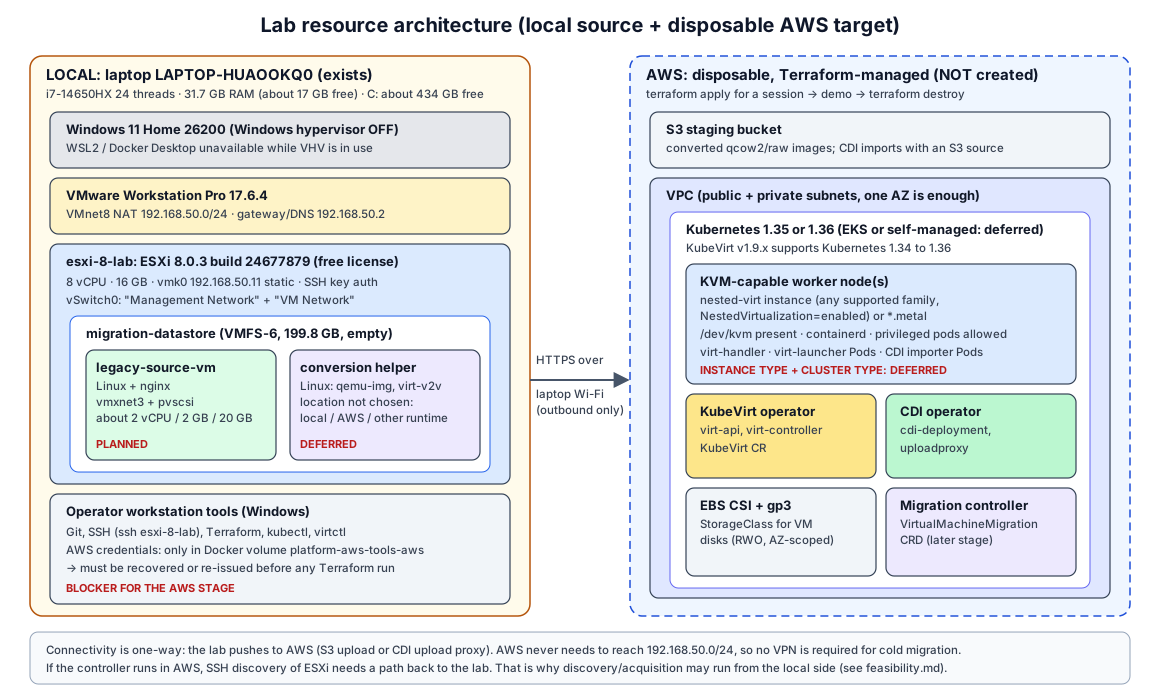
Local (exists today, OBSERVED)
| Resource | Value |
|---|---|
| Laptop | Intel i7-14650HX (16 cores / 24 threads), 32 GB RAM, ~434 GB free on C: |
| OS | Windows 11 Home 10.0.26200, Windows hypervisor off (so WSL2 and Docker Desktop are unavailable) |
| Hypervisor | VMware Workstation Pro 17.6.4, native CPL0 monitor |
| Network | VMnet8 NAT 192.168.50.0/24, gateway/DNS .2, DHCP .128-.254; avoid .10, .20, .25 (upstream conflict) |
| Nested ESXi | esxi-8-lab: 8 vCPU, 16 GB, VHV on, ESXi 8.0.3 build 24677879, 192.168.50.11 static |
| Datastore | migration-datastore, VMFS-6, 199.8 GB (198.3 GB free) |
| Source VM | Not created (planned legacy-source-vm, e.g. 2 vCPU / 2 GB / 20 GB thin) |
Resource budget inside ESXi: 8 vCPU and ~14 GB usable for nested guests. A small source VM fits comfortably, with room for a Linux conversion helper if the local option is chosen (INFERRED; the conversion location is a deferred decision).
Cloud (planned, not created, disposable, Terraform only)
| Resource | Proposal (to be decided in a later stage) |
|---|---|
| Region | One region, one AZ for the VM worker (EBS is AZ-scoped) |
| Network | Small VPC, public + private subnets, NAT or VPC endpoints for S3/ECR |
| Cluster topology | Deferred. EKS and self-managed Kubernetes (for example kubeadm on EC2) are parallel, unvalidated options. The deciding question is whether the worker architecture meets KubeVirt’s host requirements (feasibility section 5). |
| Kubernetes version | Part of the compatibility tuple chosen at deployment time; 1.35 or 1.36 are inside the KubeVirt v1.9 window (1.34 EOL 2026-10-27) |
| VM worker nodes | KVM-capable node(s): a nested-virtualization-capable EC2 instance or *.metal. Instance family, size, Region and AMI are deferred (supported families). |
| System nodes | Small general-purpose node(s) for KubeVirt/CDI control components |
| Storage | EBS CSI driver, gp3 StorageClass (RWO, WaitForFirstConsumer) |
| Staging | S3 bucket, block public access, SSE, lifecycle expiry |
| Access | Short-lived credentials; no long-lived keys in the repo |
| Cost control | Everything created by terraform apply and removed by terraform destroy after each session; tags on every resource |
Why disposable: VM-capable instances cost money every hour; the source of truth is Git + Terraform, so the environment can be rebuilt on demand. Recorded in ADR 002.
Connectivity
- Lab -> AWS: outbound HTTPS only (S3 upload, or CDI upload proxy through an exposed endpoint). No inbound path to the laptop is needed for cold migration.
- AWS -> lab: none required. VPN is deferred until a use case needs it (for example warm migration or direct VDDK reads, both out of scope).
Current blockers for the cloud side
- AWS credentials are only in the Docker volume
platform-aws-tools-aws, which cannot be read while Docker Desktop is down (hypervisor off). They must be recovered or re-issued before any Terraform work. - Conversion host: conversion tools need Linux. Windows intentionally runs without the Windows hypervisor so nested ESXi can use VMware’s native virtualization mode, so WSL2 and Docker are not available in this mode. This is a lab architecture constraint, not a production limitation. Options (local helper Linux environment, AWS conversion helper, or another controlled Linux runtime) stay open: feasibility section 6.
4. Decisions
| Decision | ADR |
|---|---|
| Local nested ESXi is the migration source | ADR 001 |
| AWS is the disposable migration target, Terraform only | ADR 002 |
| Cold migration before warm; no custom warm engine | ADR 003 |
| KubeVirt (with CDI) is the VM destination | ADR 004 |
| A custom Kubernetes controller (not scripts) will own the migration workflow | ADR 005 |