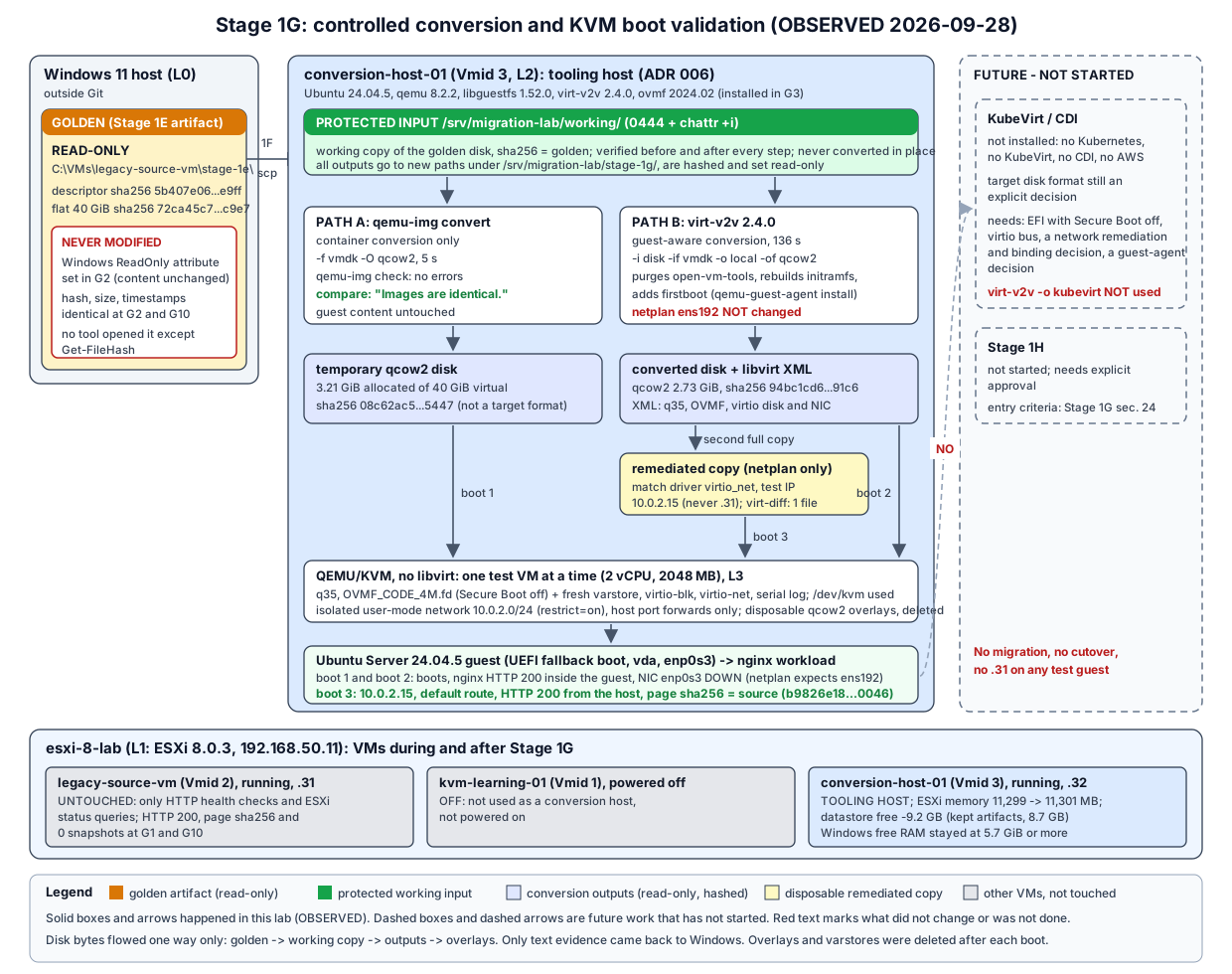
| Field | Value |
|---|---|
| Project | Project 1.5: VM-to-Kubernetes Migration Platform |
| Stage | 1G |
| Date | 2026-09-28 (all times UTC; work 03:16 to 03:59) |
| Approval | Explicitly approved by the user: record the conversion-host decision as an ADR, run controlled conversion experiments with qemu-img and virt-v2v on disposable working data, boot the results in one temporary QEMU/KVM test VM at a time, and apply minimal remediation only to a disposable converted copy. Not approved: modifying or shutting down legacy-source-vm, modifying the golden disk, in-place conversion, Kubernetes/KubeVirt/CDI, AWS, a real migration, virt-v2v -o kubevirt, using kvm-learning-01, Stage 1H. |
| Result | Success (G1 to G10 PASS). Both conversion paths produced disks that boot under QEMU/KVM with UEFI (OVMF, Secure Boot off) on virtio storage. Neither path produced a working network: netplan still matches the VMware name ens192 and the virtio NIC is enp0s3. qemu-img changed only the container (images compare identical). virt-v2v removed open-vm-tools, rebuilt the initramfs and added a first-boot service, but left netplan, GRUB configuration and identity alone. One netplan change on a second disposable copy gave a working network, and nginx returned HTTP 200 with the source page hash. The golden artifact and the source VM are unchanged. |
| Related | ADR 006 (conversion host), Stage 1F record (host, toolchain, working copy), Stage 1E record (golden artifact), Stage 1C record (source baseline), Stage 1 index |
Labels: OBSERVED = seen in this lab by a command we ran. INFERRED = reasoned from observations or documentation, not directly tested. NOT TESTED = deliberately not done.
Diagram: stage-1g-conversion-and-boot.svg.
Produce experimental evidence, not assumptions, for the ten Stage 1G questions:
| # | Question | Answer (OBSERVED unless marked) |
|---|---|---|
| 1 | What does container-only conversion do? | qemu-img convert -f vmdk -O qcow2 rewrote the container in 5 s. qemu-img compare reports the guest-visible bytes identical. Nothing inside the guest changed. |
| 2 | What does virt-v2v change? | It purged open-vm-tools, added bochs to the initramfs module list and rebuilt the initramfs (the old one kept as .pre-v2v), added alias scsi_hostadapter virtio_blk, and installed a guestfs-firstboot service that tries to install qemu-guest-agent. It did not change netplan, fstab, grub.cfg, the ESP, machine-id, SSH host keys or nginx. |
| 3 | Does the guest boot under QEMU/KVM? | Yes, all three disks: UEFI through the ESP fallback loader, Hypervisor detected: KVM, root prompt on serial in 56 to 67 s. |
| 4 | Does storage become VirtIO? | Yes. The disk is vda on virtio-blk (built into the kernel), and root and ESP mount by UUID with no change. |
| 5 | What happens to the VMware network config? | Nothing, in either path. netplan still generates [Match] Name=ens192, which matches no device. |
| 6 | Does the guest get networking with a VirtIO NIC? | Not without remediation: enp0s3 is DOWN and unmanaged. After matching by driver on a second copy: routable, 10.0.2.15/24, default route, HTTP 200 from outside the guest. |
| 7 | What happens to open-vm-tools? | qemu-img path: still enabled, but systemd skips it (ConditionVirtualization=vmware). virt-v2v path: purged (package state un, unit and binaries gone). |
| 8 | Does nginx stay intact? | Yes, in every boot: config and page hashes identical, service active, local HTTP 200 with page sha256 b9826e18...0046. |
| 9 | Which changes are automatic, which need remediation? | Automatic: sections 16 and 19. Manual: the netplan interface match (section 20). |
| 10 | What will KubeVirt/CDI need? | Section 22: EFI with Secure Boot off, a virtio disk bus, a network remediation decision, a guest-agent decision, and an explicit target-format decision. |
Authorized by the user for this stage: record the conversion-host decision as an ADR; create disposable working copies and outputs; run controlled VMDK conversion experiments; use qemu-img on working data; use virt-v2v on the working artifact; create one temporary QEMU/KVM validation VM; boot the converted guest; inspect its hardware, filesystem, boot and networking behaviour; apply minimal guest remediation only to disposable converted copies; validate nginx on the converted guest.
Not authorized, and not done: modifying or shutting down legacy-source-vm; modifying the Stage 1E golden disk; converting the golden disk in place; installing Kubernetes, KubeVirt or CDI; creating AWS infrastructure; performing a VMware -> KubeVirt migration; using kvm-learning-01 as a conversion host; starting Stage 1H.
| Done | Not done (as required) |
|---|---|
| ADR 006 for the conversion host | No change to legacy-source-vm (no shutdown, snapshot, config or guest change) |
| Golden artifact re-verified; Windows read-only attribute set on descriptor and flat extent | Golden artifact never opened by any tool except Get-FileHash |
OVMF installed on conversion-host-01 (one package) |
No other package installed or upgraded; virt-v2v stayed at 2.4.0 |
Path A: qemu-img convert of the working copy to a new qcow2 |
No in-place conversion, rebase, amend, resize, commit or check -r |
Path B: virt-v2v -i disk ... -o local to a new directory |
No connection to ESXi or vCenter; no -i vmx, no -o kubevirt; not pointed at the running source |
| Three QEMU/KVM boots (Path A, Path B unmodified, Path B remediated), one at a time, directly with QEMU (no libvirt) | 192.168.50.31 never assigned to a test guest; test guests only on an isolated user-mode network |
| One netplan remediation on a second, full copy of the virt-v2v output | No Kubernetes, KubeVirt, CDI, AWS, controller or migration work; kvm-learning-01 stayed powered off |
| Point in time (UTC) | Windows free RAM | ESXi memory used | Datastore free (bytes) | conversion-host-01 memory available |
|---|---|---|---|---|
| Before experiments (03:16 to 03:20) | 6.2 GiB | 11,299 MB | 176,174,399,488 | 7,386 MiB of 7,940 |
| During test-guest boots (03:27 to 03:56) | 5.7 to 5.9 GiB | - | - | 6,459 MiB minimum (QEMU RSS 634 to 988 MB) |
| Final (03:58) | 5.8 GiB | 11,301 MB | 166,960,562,176 | 7,402 MiB |
fstrim returned 961 MiB of deleted overlays and temporary files.-i vmx, -o kubevirt or virt-v2v’s handling of a networked first boot.fsck) of any image.ADR 006 records that conversion-host-01 is the dedicated lab host for disk inspection, conversion and QEMU/KVM boot validation, separate from legacy-source-vm and kvm-learning-01. It fixes the operating rules used here: golden read-only, working copy as the only tool input, new output paths, disposable overlays, one test guest at a time, no connection from conversion tools to ESXi. It explicitly does not decide the KubeVirt target format, where production conversion runs, or the cutover network policy.
OBSERVED on conversion-host-01 (Ubuntu 24.04.5, kernel 6.8.0-142-generic) at 03:19 (G3):
| Component | Version |
|---|---|
| qemu-img, qemu-system-x86_64 | 8.2.2 (packages qemu-utils, qemu-system-x86 1:8.2.2+ds-0ubuntu1.18) |
| libguestfs, guestfish, virt-inspector | 1.52.0 (libguestfs0t64 1:1.52.0-5ubuntu3, guestfs-tools 1.52.0-2ubuntu5) |
| virt-v2v | 2.4.0 (virt-v2v 2.4.0-2build4) |
| nbdkit / supermin | 1.36.3 / 5.2.2 |
| ovmf | 2024.02-2ubuntu0.9 (installed in this stage, section 7) |
| ipxe-qemu / seabios | 1.21.1+git-20220113.fbbdc3926-0ubuntu2 / 1.16.3-2 (already present) |
| python3 | 3.12.3 (serial and monitor test harness) |
KVM: /dev/kvm present (root:kvm), kvm_intel loaded with nested=Y, kvm-ok: “KVM acceleration can be used”. virt-v2v 2.4.0 needed no upgrade: it handled the guest completely.
Before G3, the host had no usable UEFI firmware: ovmf was not installed and neither /usr/share/OVMF nor /usr/share/qemu/firmware/ existed. The source VM boots UEFI with Secure Boot off (Stage 1C), so a BIOS boot would not be an equivalent test and was not used.
| Step (OBSERVED) | Result |
|---|---|
apt-get -s install --no-install-recommends ovmf |
One package: ovmf 2024.02-2ubuntu0.9, no dependencies |
| Install | Exit 0, no errors or warnings |
| Firmware used | /usr/share/OVMF/OVMF_CODE_4M.fd (sha256 949bfa53...a446), read-only pflash |
| Variable-store template | /usr/share/OVMF/OVMF_VARS_4M.fd (sha256 5d2ac383...5d1e), copied fresh for each boot, deleted afterwards |
| Descriptor that matches | /usr/share/qemu/firmware/60-edk2-x86_64.json: “UEFI firmware for x86_64, without Secure Boot, optional SMM, empty varstore” |
| Also installed, not used | OVMF_CODE_4M.secboot.fd (with .ms and .snakeoil links), OVMF_VARS_4M.ms.fd, OVMF_VARS_4M.snakeoil.fd; descriptors 40-...-secure-enrolled, 50-...-secure, 60-...-amdsev |
Boot path, OBSERVED identically in all three boots:
Boot0001 "UEFI Misc Device" PciRoot(0x0)/Pci(0x2,0x0) (the virtio-blk disk). It loaded the removable-media fallback \EFI\BOOT\BOOTX64.EFI, which is shim (same sha256 as EFI/ubuntu/shimx64.efi).Boot0003 "Ubuntu" HD(1,GPT,408d91cb-...)/File(\EFI\ubuntu\shimx64.efi) entry existed after boot and led BootOrder: 0003,0001,0000,0002, while BootCurrent was 0001. That shim’s fallback (fbx64.efi with BOOTX64.CSV) created it is INFERRED. No reset was seen in the serial log.efi: EFI v2.7 by Ubuntu distribution of EDK II, secureboot: Secure boot disabled, DMI: QEMU Standard PC (Q35 + ICH9, 2009), BIOS 2024.02-2ubuntu0.9. /sys/firmware/efi was present.So the VMware .nvram is not needed: a fresh variable store boots this disk through the fallback loader.
The golden artifact is C:\VMs\legacy-source-vm\stage-1e\ on the Windows host, outside Git.
| File | sha256 | Size (bytes) | LastWriteTimeUtc | Attributes at G2 start | After G2 | At G10 |
|---|---|---|---|---|---|---|
legacy-source-vm-flat.vmdk |
72ca45c7bcb2fc617e53f6286832d6d53d74e9801a18fb295c5fb88de1f9c9e7 |
42,949,672,960 | 2026-09-27T14:20:09.0410349Z | Archive | ReadOnly, Archive | same hash, size, time; ReadOnly, Archive |
legacy-source-vm.vmdk |
5b407e06ec29cac925a4504978ca3cef5d231398536ab476bcd03acbdc5de9ff |
541 | 2026-09-27T14:15:32.6800994Z | Archive | ReadOnly, Archive | same hash, size, time; ReadOnly, Archive |
IsReadOnly changed only the attribute: hash, size and LastWriteTimeUtc stayed identical. A test open for writing was then refused (“Access … is denied”).Get-FileHash touched these files in this stage. The source VM was never pointed at any converted image.| Check | G1 (03:16) | G10 (03:58) |
|---|---|---|
| Vmid 2 power state / snapshots | Powered on / 0 | Powered on / 0 |
| Guest IP and tools (ESXi) | 192.168.50.31, tools running | 192.168.50.31, tools running |
| HTTP from Windows | 200, 267 bytes | 200, 267 bytes |
| Page sha256 (Windows and ESXi) | b9826e18...0046 |
b9826e18...0046 |
Vmid 1 kvm-learning-01 |
Powered off | Powered off |
The source was only probed over HTTP and through ESXi status queries.
GOLDEN (Windows, read-only attribute)         never opened by tools
  |  Stage 1F scp (earlier, hash-verified)
PROTECTED INPUT  /srv/migration-lab/working/  0444 + chattr +i, sha256 checked before and after every step
  |-- qemu-img convert  -> stage-1g/qemu-img/legacy-source-vm.qcow2            0444, hashed
  |-- virt-v2v -o local -> stage-1g/virt-v2v/local-out/legacy-source-vm-sda    0444, hashed
                              + legacy-source-vm.xml
                           cp --sparse=always -> stage-1g/virt-v2v/remediated/legacy-source-vm-netfix.qcow2
                              (netplan changed, then 0444, hashed)
  each boot: stage-1g/boot-tests/<name>/overlay.qcow2 (backing = an output) + OVMF_VARS.fd copy  -> deleted
Directories used: /srv/migration-lab/stage-1g/{source-verification,qemu-img,virt-v2v,boot-tests,evidence}. Boot overlays are qcow2 files whose backing file is a read-only output. QEMU opens the backing file read-only, so the conversion outputs never change while a guest runs. Each output was re-hashed after every boot and at the end.
| Kept artifact (outside Git) | Size (bytes) | sha256 |
|---|---|---|
qemu-img/legacy-source-vm.qcow2 |
3,444,572,160 | 08c62ac514d28f4b29ad22df342d5b9b5a701fdb3a2081f8a484dfc50fa45447 |
virt-v2v/local-out/legacy-source-vm-sda (qcow2) |
2,926,706,688 | 94bc1cd6beb730831dd087c6e36dc6ee7d21881f43455ff44d059e55fe1d91c6 |
virt-v2v/local-out/legacy-source-vm.xml |
1,795 | a22033cea792d8d08d0bbfab2c6b5b62dd15a0155b8b2ea76e7d5665482cca84 |
virt-v2v/remediated/legacy-source-vm-netfix.qcow2 |
2,926,837,760 | 5326b13091bbc0302628b9dbf9f778ce5ff1371955bd93c8a99527a94e39d3d6 |
virt-v2v/remediated/50-cloud-init.yaml.remediated |
463 | 90e0ed3c1d21846499149f042213739312bdee6387c8d2472cf377c94573181d |
Test-harness instrumentation (overlays only, not remediation). To get a shell on guests that have no network, each boot overlay received the same two additions through guestfish before boot: serial-getty@ttyS0.service enabled, and a drop-in giving it root autologin. These existed only in the overlays, which were deleted, and never in a conversion output or in the remediated copy. The file-level diffs in sections 14 and 17 were taken on the outputs, not on the overlays. No guest password was copied to the conversion host.
Cleanup (G10, recorded in evidence/cleanup-deleted.txt): three overlay.qcow2 files (12,386,304; 146,407,424; 31,129,600 bytes), three OVMF_VARS.fd copies (540,672 bytes each), QEMU sockets and pid files, and temporary script and evidence copies in /tmp. Kept: the five artifacts above, the Stage 1F working copy, all text evidence and the harness scripts. fstrim -v / then trimmed 961.1 MiB. No QEMU process is running.
| Item | OBSERVED (G5, 03:24) |
|---|---|
| Input | /srv/migration-lab/working/legacy-source-vm.vmdk (vmdk, create type vmfs, 40 GiB virtual, 3.14 GiB on disk); sha256 check OK before |
qemu-img measure -f vmdk -O qcow2 |
required 3,448,897,536 bytes; fully allocated 42,956,488,704 |
| Command | qemu-img convert -f vmdk -O qcow2 /srv/migration-lab/working/legacy-source-vm.vmdk /srv/migration-lab/stage-1g/qemu-img/legacy-source-vm.qcow2 |
| Duration | 5 s, exit 0 |
| Output format | qcow2, compat 1.1, cluster 65,536, compression type zlib available but 0.00% compressed clusters (no -c), lazy refcounts off |
| Size | virtual 42,949,672,960 bytes; file 3,444,572,160 bytes (3.21 GiB); 52,522 of 655,360 clusters allocated (8.01%) |
Sparsity (qemu-img map) |
3,442,081,792 bytes data; 39,507,591,168 bytes read as zero and not stored |
qemu-img check |
“No errors were found on the image.” |
qemu-img compare -f vmdk -F qcow2 (default) |
“Images are identical.” (5 s) |
qemu-img compare -s (strict) |
“Offset 4096 block status mismatch!”: strict mode also compares allocation. Zero ranges are unallocated in the qcow2 but present in the flat extent. Not a content difference. |
| Input after | sha256 check OK, chattr +i still set |
Conclusion: the container changed (VMDK descriptor + flat extent -> one sparse qcow2 file), and every guest-visible byte stayed the same. qcow2 was used as a temporary experimental format only. It is not the KubeVirt target decision.
The boot was run directly with QEMU, without libvirt (G6, 03:27 to 03:31):
qemu-system-x86_64 -name path-a,process=qemu-path-a -machine q35,accel=kvm -cpu host -smp 2 -m 2048 \
  -drive if=pflash,format=raw,readonly=on,file=/usr/share/OVMF/OVMF_CODE_4M.fd \
  -drive if=pflash,format=raw,file=<boot dir>/OVMF_VARS.fd \
  -drive file=<boot dir>/overlay.qcow2,format=qcow2,if=none,id=disk0 -device virtio-blk-pci,drive=disk0,bootindex=1 \
  -netdev user,id=net0,restrict=on,hostfwd=tcp:127.0.0.1:18080-:80,hostfwd=tcp:127.0.0.1:12222-:22 \
  -device virtio-net-pci,netdev=net0,mac=52:54:00:1a:00:01 \
  -chardev socket,id=ser0,path=<boot dir>/serial.sock,server=on,wait=off,logfile=<boot dir>/serial.log -serial chardev:ser0 \
  -monitor unix:<boot dir>/monitor.sock,server=on,wait=off -display none -daemonize -pidfile <boot dir>/qemu.pid
The other two boots used the same command, differing only in name, overlay and MAC (52:54:00:1b:00:01, 52:54:00:1c:00:01).
| Item | Path A result (OBSERVED) |
|---|---|
| Boot | Success: root shell on serial 67 s after launch; systemd-analyze: 20.6 s kernel + 10.5 s userspace = 31.1 s; is-system-running: running, 0 failed units |
| Firmware | UEFI (OVMF 2024.02), Secure Boot disabled, fallback boot path (section 7) |
| CPU / memory | 2 vCPU, Intel Core i7-14650HX (host model passed through), 1,961 MiB visible |
| Kernel | 6.8.0-142-generic, root=UUID=db8b3bb3-e776-42e8-902e-89124606b2f6 ro (unchanged command line) |
| Block device | vda (virtio-blk 1af4:1001); vda1 vfat C340-CD01 on /boot/efi, vda2 ext4 db8b3bb3-... on / |
| NIC | enp0s3 (virtio-net 1af4:1000, driver virtio_net), renamed from eth0 at 16.8 s |
| Network | None: link DOWN, unmanaged, no address, no route (section 13) |
| nginx | enabled, active, listening on :80 and [::]:80; guest-local curl HTTP 200, 267 bytes, sha256 b9826e18...0046 |
| Host-side HTTP / SSH via port forward | No answer (the guest had no address) |
| Shutdown | ACPI system_powerdown via the monitor; QEMU exited, none left running |
| Evidence | Path A | Path B unmodified | Path B remediated |
|---|---|---|---|
| QEMU process fds | /dev/kvm, kvm-vm, kvm-vcpu:0, kvm-vcpu:1 |
same | same |
HMP info kvm |
kvm support: enabled | enabled | enabled |
Guest systemd-detect-virt |
kvm | kvm | kvm |
| Guest dmesg | “Hypervisor detected: KVM”, kvm-clock | same | same |
| Virtio block / net PCI devices | 1af4:1001 / 1af4:1000 |
same | same |
All three guests ran KVM-accelerated. No software-emulation (TCG) boot was run in this stage, so none is compared.
/dev/vda instead of the VMware /dev/sda (PVSCSI). Nothing in the guest depends on the name: fstab mounts / and /boot/efi by UUID, GRUB finds root by UUID, and swap is the file /swap.img (OBSERVED in all three boots).virtio_blk, virtio_net, virtio_scsi and virtio_pci are built into the kernel (modules.builtin). Path A, with an unchanged initramfs, booted from virtio-blk, so no initramfs rebuild was needed for storage on this guest.vmw_pvscsi and vmxnet3 were not loaded in any boot. Both are still present as modules, and still in the initramfs after virt-v2v (lsinitramfs).sr0, which are unused. Filesystem and partition UUIDs are unchanged in all images.OBSERVED identically in Path A and Path B unmodified:
enp0s3 (virtio_net, PCI 00:03.0). The kernel logged virtio_net virtio1 enp0s3: renamed from eth0. ens192 does not exist./etc/netplan/50-cloud-init.yaml, unchanged) generated /run/systemd/network/10-netplan-ens192.network with [Match] Name=ens192, static 192.168.50.31/24, gateway and DNS 192.168.50.2.networkctl: enp0s3 ether off unmanaged. There was no IPv4 address, no route, no DHCP attempt (dhcp4: false, and no configuration matched anyway). ping 10.0.2.2: “Network is unreachable”.systemd-networkd-wait-online was skipped by its netplan condition, so the boot did not stall. The guest looked healthy (running, nginx active) while it was unreachable.Confirmed migration risk: the Stage 1C/1F prediction holds. A VMware-to-KVM move leaves this guest without network, because the configuration is keyed to the VMware interface name. The new name reflects the PCI slot the NIC gets (enp0s3 here). A different virtual hardware layout, such as KubeVirt’s, may produce a different name (INFERRED).
Documentation read first (G8, local, version-exact): virt-v2v --help, --machine-readable, man pages virt-v2v(1), virt-v2v-input-vmware(1), virt-v2v-output-local(1) and virt-v2v-support(1). From them:
-i disk reads “a virtual machine disk image with no metadata” (single disk only). -if gives its format.-o local -os DIR writes NAME-sda plus a libvirt NAME.xml.-of: “If not specified, then the input format is used” (here: vmdk).disk, libvirt, libvirtxml, ova, vmx. Outputs include local, qemu, libvirt, kubevirt, openstack. Ubuntu 10.04 and later are listed as supported, and UEFI guests are supported on libvirt/qemu with OVMF.-i list and -o list are not accepted by 2.4.0 (“unknown -i option: list”). The machine-readable feature list was used instead. In-place conversion is not an option of this command.Choices: -i disk -if vmdk on the protected working copy, because it is local, needs no .vmx and no connection. -o local gives local files. -of qcow2 was set explicitly: the default would have re-emitted VMDK, and qcow2 matches Path A’s container, so differences between the paths are guest-level only.
| Item | OBSERVED (03:33 to 03:35) |
|---|---|
| Command | virt-v2v -v -x -i disk -if vmdk /srv/migration-lab/working/legacy-source-vm.vmdk -o local -os /srv/migration-lab/stage-1g/virt-v2v/local-out -of qcow2 (as root, LIBGUESTFS_BACKEND=direct, debug log 1,337,026 bytes) |
| Before | virt-v2v 2.4.0; input vmdk 40 GiB; sha256 check OK; chattr +i set |
| Duration | 136 s, exit 0 |
| Stages | 0.0 set up source; 1.0 open; 42.4 inspect; 49.3 free-space check; 49.3 “Converting Ubuntu 24.04.5 LTS to run on KVM”; 121.2 map filesystem data; 125.9 close overlay; 127.0 assign buses, BIOS/UEFI check; 128.1 copy disk 1/1; 136.3 metadata, finish |
| Warnings | One: “virt-v2v: warning: could not determine a way to update the configuration of Grub2” (it looked for grub2-mkconfig and grub-mkconfig and found neither; bootloader detected at /boot/efi/EFI/ubuntu/grub.cfg) |
| Produced files | legacy-source-vm-sda: qcow2, 40 GiB virtual, 2,926,706,688 bytes (2.73 GiB), 44,573 clusters (6.80%), check clean. legacy-source-vm.xml: 1,795 bytes. |
| Input after | sha256 check OK, chattr +i still set: virt-v2v read the input without modifying it |
qemu-img compare vs input |
“Content mismatch at offset 1128268800!” (expected: the guest was changed) |
The output is smaller than Path A (2.73 vs 3.21 GiB) because virt-v2v maps filesystem data and skips unused blocks (“Mapping filesystem data to avoid copying unused and blank areas”).
Generated libvirt XML (summary): domain type='kvm', libosinfo ubuntu/24.04, 2 GiB memory, 1 vCPU, cpu mode='host-model', machine q35, loader readonly='yes' type='pflash' /usr/share/OVMF/OVMF_CODE_4M.fd with nvram template OVMF_VARS_4M.fd, disk qcow2 on target dev='vda' bus='virtio', interface network='default' model virtio, VGA video, virtio RNG, virtio balloon, vsock, a virtio-serial controller with the org.qemu.guest_agent.0 channel. The memory and vCPU values are -i disk defaults, not the source’s 2 vCPU / 4096 MB. Metadata has to come from the .vmx, not from this output.
What changed in the guest (virt-diff input vs output, 396 lines, confirmed from the debug log):
| Change | Detail |
|---|---|
| open-vm-tools purged | dpkg --purge open-vm-tools: binaries (vmtoolsd, vmware-*, VGAuthService, vmhgfs-fuse), libraries, plugins, /etc/vmware-tools/, /etc/pam.d/vmtoolsd, units, rc links, udev rules 60-open-vm-tools.rules and 99-vmware-scsi-udev.rules removed |
| initramfs | /etc/initramfs-tools/modules: comment “The following modules were added by virt-v2v” + bochs (virtio already built in); update-initramfs -v -c -k 6.8.0-142-generic; old image kept as /boot/initrd.img-6.8.0-142-generic.pre-v2v (75,988,137 bytes; new 75,984,098) |
| Module alias | New /etc/modprobe.d/virt-v2v-added.conf: alias scsi_hostadapter virtio_blk |
| First-boot service | /usr/lib/systemd/system/guestfs-firstboot.service (oneshot, After=network.target) + SysV links; /usr/lib/virt-sysprep/firstboot.sh with scripts 5000-0001-wait-online, 5000-0002-setenforce-0, 5000-0003-install-qga (apt-get update + apt-get install qemu-guest-agent), 5000-0004-setenforce-restore, 5000-0005-start-qga |
| Package database | /var/lib/dpkg/status rewritten by the purge (other packages’ conffile records normalized; no package files changed) |
| Incidental | /etc/ld.so.cache (libc trigger), /run/blkid, /run/needrestart |
Unchanged (checksum-identical to the source reference, OBSERVED with guestfish --ro): /etc/netplan/50-cloud-init.yaml, /etc/fstab, /boot/grub/grub.cfg, /boot/efi/EFI/ubuntu/grub.cfg, /boot/efi/EFI/BOOT/BOOTX64.EFI, /boot/efi/EFI/ubuntu/shimx64.efi, /etc/machine-id, all three SSH host public keys, /etc/nginx/nginx.conf, /etc/nginx/sites-available/default, /var/www/html/index.html, the cloud-init disabled marker. No udev or systemd-networkd rules were added.
Path B unmodified: the untouched virt-v2v output under an overlay (03:43 to 03:45).
| Item | OBSERVED |
|---|---|
| Boot | Success: root shell on serial 58 s after launch. is-system-running: starting, because guestfs-firstboot was still running (section 17) |
| Firmware | UEFI, Secure Boot disabled, same fallback path and boot entries as Path A |
| Kernel / cmdline | 6.8.0-142-generic, root=UUID=db8b3bb3-... (unchanged) |
| Storage | vda1 / vda2, mounts by UUID, same as Path A; initramfs contains bochs |
| NIC / network | enp0s3 DOWN, unmanaged; netplan ens192 unchanged: same failure as Path A |
| open-vm-tools | not-found (package un, no /usr/bin/vmtoolsd) |
| qemu-guest-agent | Not installed; the first-boot script was waiting (systemd-networkd-wait-online --timeout=30), and nmcli: not found was logged by the wait-online script |
| cloud-init | disabled by marker file (unchanged) |
| machine-id, SSH host keys | sha256 identical to the source; fingerprints ECDSA 9z1UPwZW..., ED25519 7Nw9FkUR..., RSA UXiyMja/... identical |
| nginx | enabled, active, :80; config and page hashes identical; local HTTP 200 with sha256 b9826e18...0046 |
| VMware-specific item (Stage 1F list) | After qemu-img (Path A) | After virt-v2v (Path B) |
|---|---|---|
| PVSCSI disk controller | Not needed: virtio-blk built in, vda, boots |
Same; plus alias scsi_hostadapter virtio_blk and a rebuilt initramfs |
| VMXNET3 NIC | Replaced by virtio-net enp0s3, which gets no configuration |
Same |
netplan keyed on ens192 |
Unchanged, fails | Unchanged, fails |
ens192 in /etc/cloud/cloud.cfg.d/90-installer-network.cfg |
Unchanged (cloud-init disabled, so inert) | Unchanged |
| open-vm-tools | Installed and enabled, skipped at boot by ConditionVirtualization=vmware |
Purged |
| VMware udev rules | Present | Removed with the package |
| Guest agent for the new hypervisor | None | None yet; first boot tries to install qemu-guest-agent from the Ubuntu archive |
| UEFI boot without VMware NVRAM | Works via fallback loader | Works via fallback loader; grub.cfg not regenerated (warning), not needed here |
| Identity (machine-id, SSH keys, FS UUIDs, hostname) | Preserved | Preserved |
The unmodified virt-v2v result was recorded first (section 15). Then a second disposable copy was made and changed (G9, 03:46):
cp --sparse=always of local-out/legacy-source-vm-sda to remediated/legacy-source-vm-netfix.qcow2. The copy’s sha256 before any change equalled the output’s (94bc1cd6...91c6)./etc/netplan/50-cloud-init.yaml, then set owner 0:0 and mode 0600 (the original’s).qemu-img check clean; mode 0444; new sha256 5326b130...d3d6. The original output still verified afterwards.Design of the change. The guest’s own configuration structure was kept: one ethernet, static address, static default route, one nameserver, dhcp4: false. Only two things changed:
match: driver: virtio_net, netplan ID primary), so it no longer depends on which PCI slot names the interface.virt-diff between the virt-v2v output and the remediated copy lists exactly one changed file:
= - 0600        235 /etc/netplan/50-cloud-init.yaml
+# Stage 1G remediation (disposable converted test copy only): match the NIC by driver instead of
+# the VMware-specific name ens192. Test address on the isolated QEMU user network, not 192.168.50.31.
 network:
   version: 2
   ethernets:
-    ens192:
+    primary:
+      match:
+        driver: virtio_net
       addresses:
-      - "192.168.50.31/24"
+      - "10.0.2.15/24"
       nameservers:
         addresses:
-        - 192.168.50.2
+        - 10.0.2.3
       dhcp4: false
       routes:
       - to: "default"
-        via: "192.168.50.2"
+        via: "10.0.2.2"
Boot of the remediated copy (03:50 to 03:56), OBSERVED:
| Proof | Result |
|---|---|
| Generated config | /run/systemd/network/10-netplan-primary.network with [Match] Driver=virtio_net |
| Interface up | enp0s3 UP, LOWER_UP; networkctl: routable, configured; netplan status: “enp0s3 ethernet UP (networkd: primary)” |
| Test address | 10.0.2.15/24 on enp0s3 |
| Default route | default via 10.0.2.2 dev enp0s3 proto static; ping 10.0.2.2: 2/2 replies |
| wait-online | systemd-networkd-wait-online active (exited), status 0 |
| DNS | Configured (10.0.2.3 on the link, systemd-resolved stub), but lookups failed (“All attempts to contact name servers or networks failed”). The isolated network (restrict=on) does not forward DNS, so DNS was not proven. |
| nginx listening | :80 and [::]:80, service active |
| HTTP from outside the guest | curl http://127.0.0.1:18080/ on the conversion host (user-network port forward to guest :80): HTTP 200, 267 bytes, sha256 b9826e18a06a354d6ba97e3419e266b1453cb2a3b0038d4b3dcd45c96c170046 (= source page) |
| SSH | ssh-keyscan through the :22 forward returned the source’s three host key fingerprints (identical) |
| 192.168.50.31 | Never assigned to any test guest |
Side finding: virt-v2v first boot on an isolated network. guestfs-firstboot ran apt-get update for the qemu-guest-agent install. With no DNS, the apt retries were still running after more than 4 minutes, so the unit stayed activating and systemctl is-system-running reported starting for the whole test. nginx and SSH were already up. The scripts not yet run (5000-0004, 5000-0005) remained queued. The oneshot has no start timeout in its unit, so how long it takes to give up was not measured (NOT TESTED).
Only what was observed is listed.
| Aspect | Path A: qemu-img | Path B: virt-v2v (unmodified) |
|---|---|---|
| Nature | Container conversion | Guest-aware conversion + container conversion |
| Time | 5 s | 136 s |
| Output | qcow2 3.21 GiB, identical guest content | qcow2 2.73 GiB (unused blocks skipped) + libvirt XML |
| Guest-visible bytes vs input | Identical | Different (files below) |
| Boots under QEMU/KVM, UEFI | Yes | Yes |
| Disk naming | vda, mounts by UUID |
Same |
| FS / partition UUIDs | Unchanged | Unchanged |
| initramfs | Unchanged, works | Rebuilt (bochs added), backup kept |
| grub.cfg / ESP | Unchanged | Unchanged (warning: could not update Grub2 config) |
| UEFI boot path | Fallback loader, fresh varstore | Same |
| netplan | Unchanged (ens192) |
Unchanged (ens192) |
| Network result | No network | No network |
| VMware Tools | Present, enabled, skipped by condition | Purged |
| Guest agent | None | Install attempted at first boot (needs repository access) |
| machine-id | Unchanged | Unchanged |
| SSH host keys | Unchanged | Unchanged |
| nginx package, config, page, service | Unchanged, HTTP 200 locally | Unchanged, HTTP 200 locally |
| Boot state at check | running |
starting (first-boot service still active) |
| VM metadata | None | XML: q35, OVMF, virtio disk and NIC, 1 vCPU / 2 GiB defaults |
By virt-v2v, all OBSERVED:
bochs added. The virtio drivers were already built in, as virt-v2v itself detected (virtio: blk=true net=true rng=true balloon=true).scsi_hostadapter alias set to virtio_blk.By qemu-img: only the container, transparently to the guest.
By the platform, in both paths (not by any tool): OVMF created boot entries for the new disk, udev named the disk vda and the NIC enp0s3, and systemd skipped VMware-only units by virtualization condition.
ens192 with a hardware-independent match (driver virtio_net) in /etc/netplan/50-cloud-init.yaml, plus an address valid for the network the guest lands on. Without it the guest boots healthy but unreachable, in both paths.virt-v2v -i vmx with the reference .vmx (would carry 2 vCPU / 4096 MB and the MAC), and -o kubevirt. Not run.fsck).All INFERRED from the Stage 1G observations and the Stage 0 design. Nothing was deployed.
| Topic | Implication |
|---|---|
| Firmware | The VM spec needs EFI boot with Secure Boot off to match what was proven. A fresh NVRAM is fine: the fallback loader works. Secure Boot on is a separate test. |
| Disk bus | virtio works without guest changes. Keep KubeVirt’s virtio disk bus; SATA or SCSI emulation is unnecessary for this guest. |
| Disk format | Both conversion outputs are qcow2. CDI stores VM disks as raw on a PVC and converts supported formats on import. Whether to hand CDI a qcow2, a raw image or the flat extent is still an explicit decision; nothing here chooses it. |
| Network | The single biggest blocker. Without a netplan change the VM boots unreachable. The driver-based match proven here is independent of the interface name, but addressing depends on the KubeVirt network binding: a pod network typically hands out an address by DHCP, while a bridged/secondary network could keep a static address. The remediation and the binding must be designed together. |
| Guest agent | virt-v2v’s first boot tries to install qemu-guest-agent from the internet. In an isolated or air-gapped cluster that stalls (observed on the isolated network). Either pre-install the agent during conversion, provide a mirror, or remove the first-boot job. |
| VMware Tools | Path A would carry an idle open-vm-tools into KubeVirt; Path B removes it. |
| Metadata | -i disk guesses 1 vCPU / 2 GiB. The VirtualMachine spec must take CPU, memory, firmware and MAC policy from the .vmx facts recorded in Stage 1C/1D. |
| Identity | machine-id, SSH host keys and hostname survive conversion. Good for continuity, but the migrated VM and the source must never run on the same network with the same address. |
| Tooling | virt-v2v 2.4.0 handled this guest fully from a local disk, which is the same pattern MTV/Forklift uses in its conversion pod (industry reference, not tested here). -o kubevirt remains unused and experimental. |
/dev/sdX fstab entries, other distributions or Windows would behave differently.Stage 1H is not defined here. Status of each criterion at the end of Stage 1G:
| Criterion | Status |
|---|---|
| Converted KVM boot path understood | Met: UEFI fallback boot on virtio-blk, three KVM boots (sections 7, 11, 15) |
| qemu-img vs virt-v2v behaviour documented | Met: sections 10, 14, 18 |
| Guest hardware adaptation understood | Met: sections 12, 16, 19 |
| Network migration risk understood | Met: confirmed failure and a proven, minimal remediation (sections 13, 17, 20) |
| One reproducible converted working image exists | Met: virt-v2v/remediated/legacy-source-vm-netfix.qcow2, sha256 5326b130...d3d6, reproducible from the working copy with the recorded commands |
| Golden copy untouched | Met: identical hashes, sizes and timestamps; only the read-only attribute added (section 8) |
| Source VM healthy | Met: powered on, .31, HTTP 200, page sha256 unchanged, 0 snapshots |
| Conversion host documented | Met: ADR 006 and section 6 |
| KubeVirt target format still an explicit decision | Met: not chosen (section 22) |
| KubeVirt/CDI not implemented | Met: nothing installed |
Stage 1H also requires the user’s explicit approval, with objective, scope and change boundary written down. No Kubernetes, KubeVirt, CDI or AWS work starts without it.
| Gate | Evidence | Result |
|---|---|---|
| G1 Repository and source state | main = origin/main = aeb7661f59038d6ca222e587ba0a034ed46c67be (Stage 1F commit), clean tree; source on, .31, HTTP 200, page sha256 from Windows and ESXi |
PASS |
| G2 Golden artifact verified and protected | Descriptor and flat sha256, size, timestamps match Stage 1E; ReadOnly attribute set with content unchanged; write-open refused (section 8) | PASS |
| G3 Conversion host ready | KVM, /dev/kvm, qemu-img, libguestfs, guestfish, virt-v2v versions; OVMF installed and paths recorded (sections 6, 7) |
PASS |
| G4 Working input baseline | qemu-img info/check, GPT layout, FS UUIDs and sizes, OS, ESP, netplan ens192 static .31, open-vm-tools enabled, cloud-init disabled, UUID mounts, vmxnet3/pvscsi modules, reference checksums; input hash OK before and after |
PASS |
| G5 Path A qemu-img conversion | Command, formats, sizes, sparsity, hash; check clean; compare: identical (section 10) |
PASS |
| G6 Path A boot | QEMU command, KVM evidence, UEFI, CPU, vda, enp0s3, kernel, mounts, nginx (section 11) |
PASS |
| G7 Path A network | ens192 absent, enp0s3 unmanaged, no address, no DHCP; migration risk confirmed; .31 not used (section 13) |
PASS |
| G8 Path B virt-v2v conversion | Local docs read; -i disk -if vmdk -o local -of qcow2; input unchanged; files, hashes, format, XML, warning and guest changes recorded (section 14) |
PASS |
| G9 Path B boot and remediation | Unmodified boot recorded; second copy with one netplan change; interface up, 10.0.2.15, default route, nginx, HTTP 200 with source page hash (sections 15, 17) | PASS |
| G10 Documentation, evidence, cleanup | This record, ADR 006, diagram, index updates; final golden/source/working-copy/output checks; overlays deleted and listed; no QEMU running | PASS |
conversion-host-01: virt-v2v --help, --machine-readable, man pages virt-v2v(1), virt-v2v-input-vmware(1), virt-v2v-output-local(1), virt-v2v-support(1) (virt-v2v 2.4.0); /usr/share/qemu/firmware/*.json (ovmf 2024.02-2ubuntu0.9).apt-cache policy/show against the noble archive, 2026-09-28.C:\VMs\conversion-host-01\stage-1g\ (G1 to G10 outputs, test harness, collected text evidence including the virt-v2v debug log, virt-diff outputs and serial logs). The disk artifacts stay on conversion-host-01 in /srv/migration-lab/stage-1g/.